

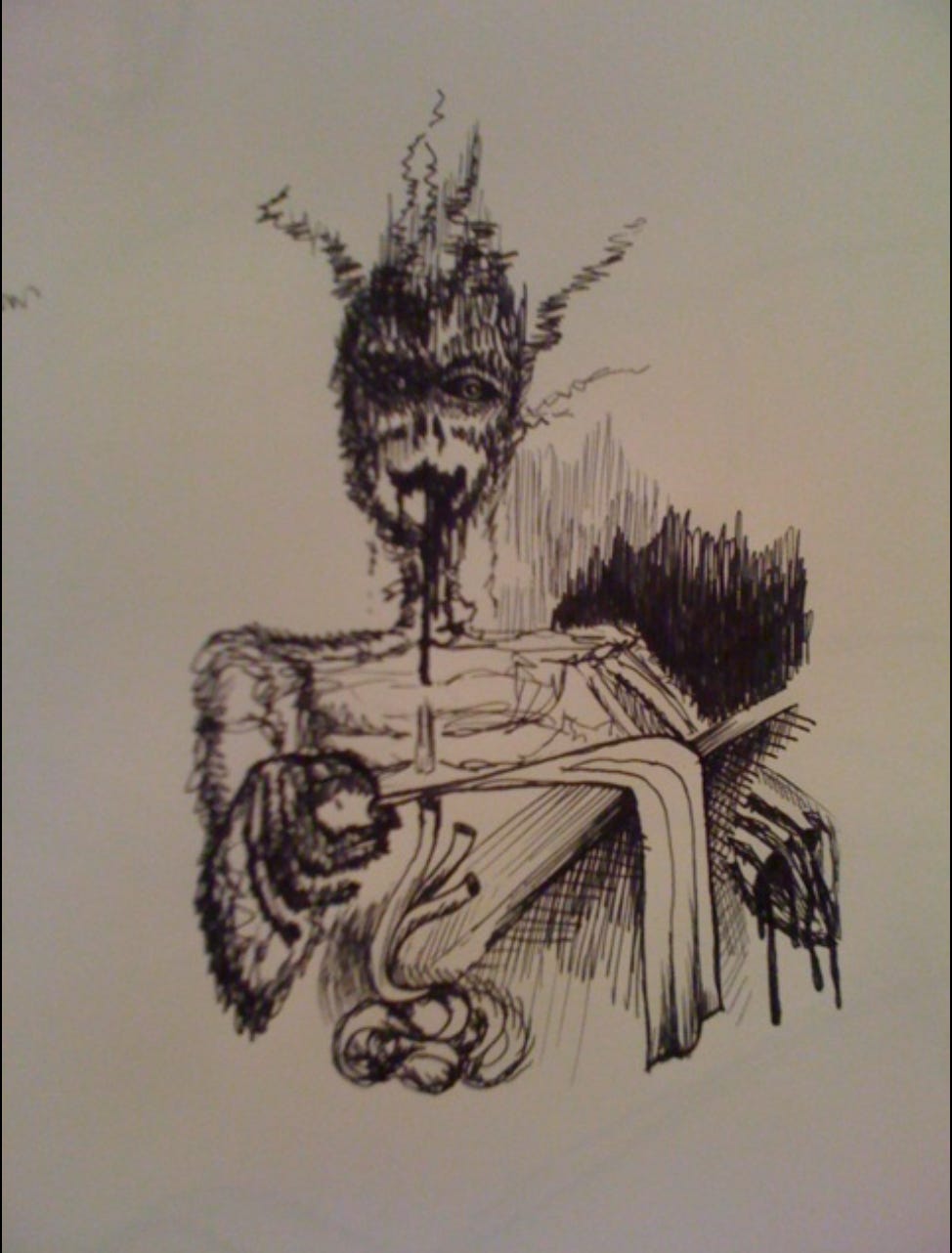
Modern culture treats depression as either a chemical defect or a psychological identity. Ancient cultures didn’t.
They treated prolonged despair, apathy, agitation, and meaning-collapse as a disturbance of energy, rhythm, and embodiment. Something that happened to a person, often at predictable times, and something that could pass if handled correctly.
Long before SSRIs and diagnostic checklists, this state had a name: acedia.
Not in Classical Greece proper, but in the Greek intellectual world that followed it—Late Antiquity, where Greek medicine, philosophy, and early Christian psychology overlapped. Acedia was famously called the noonday demon.
That detail alone matters more than people realize.
If despair reliably arrives at noon, it’s not a personality flaw. It’s a biological and rhythmic event.
Acedia is often mistranslated as “sloth,” which is unfortunate and misleading.
The original Greek word ἀκηδία means lack of care, absence of animating force, collapse of concern. Not laziness. Not indulgence. More like the soul losing traction.
The classic descriptions come from Greek-educated monastic writers, especially Evagrius Ponticus and later John Cassian, who preserved and expanded these observations. But the physiological logic behind them is unmistakably Greek.
They describe a state with strikingly modern features:
•A person becomes suddenly exhausted without having done much.
•The environment feels unbearable.
•The mind alternates between agitation and paralysis.
•Simple tasks feel impossible.
•Thoughts fragment.
•A sense of meaninglessness that feels physical
•Time stretches and distorts.
•Irritability and restlessness
•A powerful urge arises to escape—to leave, to change lives, to go somewhere else.
This tends to happen around midday. At a specific point in the day when heat rises, digestion competes for blood flow, attention drops, and energy is most vulnerable.
Greek roots: before acedia had a name
In Classical Ancient Greece, the dominant framework for depressive states was melancholia. Hippocratic medicine already linked fear, despair, withdrawal, and mental heaviness to bodily processes: digestion, bile, temperature, seasons, and daily rhythms.
The Greeks did not imagine the mind floating above the body. Mood was inseparable from circulation, heat, nourishment, and rest.
By the time acedia is named in Late Antiquity, nothing fundamentally new is invented. What happens is a refinement.
Instead of treating all low mood as one amorphous condition, acedia isolates a very specific pattern:
energy-dependent
agitation mixed with collapse
dominated by avoidance and escape fantasies
This is why acedia feels so modern. It maps cleanly onto burnout, nervous exhaustion, and the kind of depression that feels restless rather than numb.
How they treated acedia: a pro-energy doctrine
This is where the historical record becomes genuinely uncomfortable for modern sensibilities.
There was no encouragement to “explore the feeling.” No instruction to endlessly analyze one’s inner narrative. No suggestion that the feeling revealed a deep truth about the self.
Acedia was treated as a state to be resisted, outlasted, and metabolically corrected.
1. Do not flee
The first and most repeated instruction is blunt: do not run.
Acedia always whispers the same lie: “Your problem is where you are. Leave, and you’ll be free.” Ancient writers were clear that this is the trap.
If you obey the escape impulse, you train the nervous system to associate discomfort with flight. The condition returns stronger, because the underlying energy problem was never resolved.
In modern language: avoidance reinforces the pattern.
They understood this intuitively, centuries before behavioral psychology.
2. Respect for circadian rhythm
The day was structured around biology:
- rising with sun,
- productive mornings,
- rest during peak heat,
- renewed activity later in the day.
3. Movement before mood
Walking, light labor, bathing, massage—these appear again and again.
The logic is consistent: restore circulation first.
Mood was expected to follow the body, not the other way around.
This is radically different from the modern assumption that you must feel better before you can act better.
For the ancients, action came first. Feeling followed.
Descriptions of acedia repeatedly mention intense hunger or lack of appetite, heaviness, and bodily weariness as part of the attack itself.
This tells us something obvious but often ignored:
energy availability was part of the condition!
They warned against extremes. Neither starvation nor excess helped. Warm, simple food was seen as stabilizing. Small amounts of wine were sometimes used deliberately—not for escape, but for circulation and nervous calming.
This was metabolic thinking, even if they didn’t call it that.
Following older Pythagorean ideas, music and chanting were used therapeutically. Sound and rhythm were understood as direct regulators of the nervous system and vitality. For a deeper exploration, see my article on healing through music.
6. Work is medicine
Manual labor was not prescribed as punishment or moral improvement. It was prescribed because it re-anchors the body.
Repetitive movement. Predictable effort. Completion of concrete tasks. No wonder that every time I feel down, I instinctively go do something around my home—clean, fix something, or work in the garden.
Work forces circulation, stabilizes attention, and prevents mental spirals. It is all about keeping energy moving.
From a modern perspective, this looks like:
somatic regulation
nervous system entrainment
interrupting rumination with embodied action
7. Sleep was not the solution
One subtle but important point: acedia tempts a person to believe that sleep will fix everything.
Sometimes rest helps. Sometimes it doesn’t.
The ancients noticed that using sleep as escape could deepen the condition, not resolve it. Again, this aligns disturbingly well with modern experience.
Not all fatigue is solved by withdrawal. Some fatigue requires re-engagement.
Healthy sleep schedule still matters of course.
What happens after you don’t run
One of the most psychologically precise observations in the acedia literature is this:
If you stay, work, and endure the state without dramatizing it, relief often comes on its own.
A quiet clarity. A sense of peace. Sometimes even joy.
Not because you “processed” the feeling, but because the nervous system re-locked into rhythm.
This is the rebound modern people rarely reach—because we flee, distract, scroll, relocate, or re-label ourselves before it can happen.
What they understood that we forgot
Acedia was not treated as an identity.
You were not an acedic person. You were undergoing acedia.
That distinction matters.
They assumed:
states pass,
energy can be restored,
meaning returns after vitality, not before.
Modern culture inverted that order.
We now wait for meaning before acting. They acted until meaning returned.
Why this matters now
Modern life recreates acedia almost perfectly:
artificial light,
constant stimulation,
disrupted circadian rhythm,
caffeine instead of rest,
endless cognitive load without embodied release.
We call the result depression, burnout, loss of motivation.
The ancients would have recognized it instantly.
Their response was unsentimental and practical:
restore rhythm, restore movement, restore energy, refuse the escape fantasy.
Not because suffering isn’t real.
But because energy collapse lies!
Acedia convinces you that your life is wrong, your place is wrong, your work is wrong.
Sometimes that’s true. But very often, it’s just noon.
And the treatment is not a new identity. It’s food, movement, work, rhythm—and staying put long enough for your nervous system to recover.
That was the cure for the noonday demon.
And it still works.
I really appreciate this perspective, and as a psychologist I would add that most of us are trained to first look at energy basics like sleep, food and physical movement and engagement in social/productive activities (the very technical term is behavioral activation) and I explain it to my clients as “priming the pump” or reminding your system of what feels good, even when you’re not feeling motivation yet.
The problem is often from the psychiatric side, where clients are usually prescribed a drug and given a depression identity, which suggests there is something fundamentally wrong with them, which decenters agency, essentially colluding with the negative lens that the depressive state already creates.
This usually confuses the whole process of self-healing and prevents the condition from resolving as a temporary experience. It is really frustrating to see that happen to people.
There is also the concept of “susto” or soul loss, which explains depression as a temporary withdrawal or loss of connection with the soul. Sometimes there is a reason related to a persons life or past experiences that causes this to happen, and warrants some exploration. Even when this is the case, the energy approach outlined in your article is the best first line approach, and the person can begin to explore what is out of alignment when they feel a little more energy and hope.
Such a complex, nuanced human experience, and I’ve learned so much from my own experience recovering from depression, and from working with my clients.
This is very interesting, thank you. Do you recommend resting around noon? I normally start work around noon due to my schedule, this may explain why I frequently struggle with motivation around that time.