
Fascia. Pain.
Fibromyalgia, Trapped Nerves, and the Cannabinoid System Built Into Your Fascia. Part 3 of the Fascia Series.


Many people live with chronic pain that has not improved with conventional treatment. Medication did little or eventually stopped helping. Physical therapy brought relief, but the pain returned. You may have been offered injections, procedures or surgery. Perhaps you already had the surgery and, after a period of improvement, the pain came back.
You may also have been passed from rheumatology to neurology, then to orthopedics and pain management. Eventually, someone may have suggested seeing a psychologist.
Maybe you have a diagnosis such as fibromyalgia, chronic low-back pain, myofascial pain syndrome, carpal tunnel syndrome or sciatica without a convincing disc problem. Or perhaps you have a collection of symptoms that move around, disappear and return, never quite forming a diagnosis that explains the whole picture.
Either way, you may feel that you have run out of tools.
This article is for you.
The conventional treatment for chronic musculoskeletal pain has been failing for decades. NSAIDs, muscle relaxants, trigger point injections, botulinum toxin, spinal surgery. Treatments fail because we misidentify the tissue as muscle rather than fascia, and because none of these interventions address the systemic drivers that keep the fascia in a dysfunctional state. Conventional medicine does not include fascia as part of what may have gone wrong, which is why patients who bounce through it for years often find relief only when they leave the mainstream framework and find someone who understands fascia.
Under chronic stress, chronic inflammation, and chronic metabolic dysregulation, the fibroblasts that normally maintain your fascia switch to a contractile phenotype called the myofibroblast. In the course of wound healing this is to be expected; the myofibroblast will draw in the damaged tissue and lay down collagen for a stronger repair. The trouble is when they do not turn off. Ongoing inflammation or other forms of stress can leave the myofibroblasts in an active state, churning out matrix and tugging at what is around them. Before long you have tissue that is thicker and stiffer, with little give.
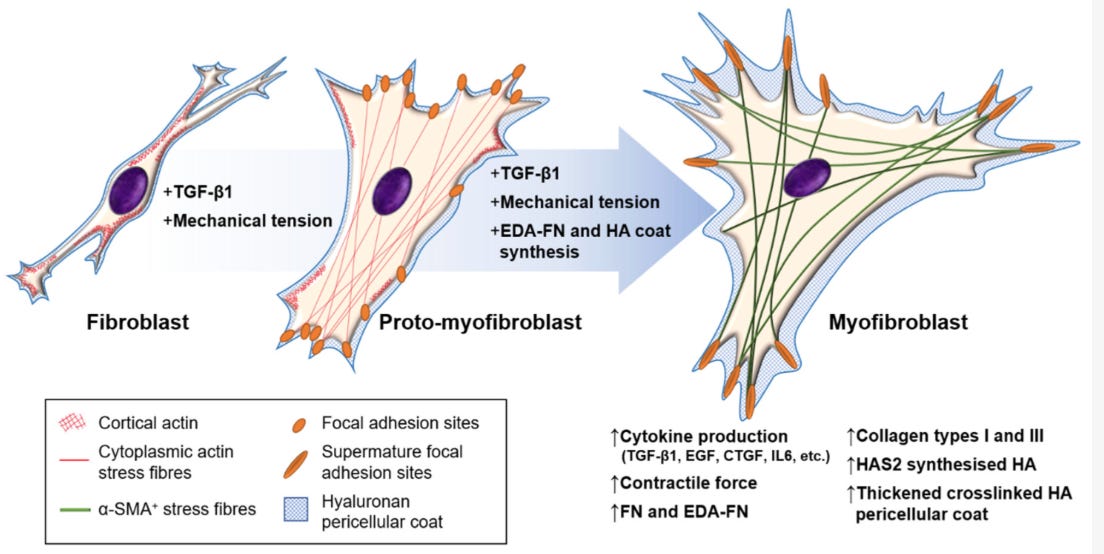
This article is long. After reviewing the research and adding some of my own observations, I will examine where the standard muscle-based model falls short and what might be driving fibroblast activation. There is also the matter of the endocannabinoid system inherent in the fascia. From there I will put the framework to work on fibromyalgia and certain nerve-compression patterns, and in the section on the nervous system I will address why sound mechanical work may offer some relief yet fail to hold. A word will be said about the neck and the fascial element of chronic headaches before I tie it all up in something more practical.
Those who have not made it through my first two pieces on fascia should go back and read them first; they cover the mechanical behavior, structure of fascia and hydration.
Section 1: The conventional model misses the fascia
The dominant framework for chronic musculoskeletal pain came from Janet Travell and David Simons. Travell was John F. Kennedy’s White House physician and one of the most influential figures in twentieth-century pain medicine. She and Simons published the two-volume Myofascial Pain and Dysfunction: The Trigger Point Manual in the 1980s. Every clinician you have ever seen for chronic musculoskeletal pain was trained on this framework.
The framework is built on identifying hyperirritable knots in taut bands of tissue (aka trigger points), and treats them locally. Palpate the trapezius, find a tender knot, press hard or needle it, feel the pain shoot along a characteristic referral pattern. Travell and Simons mapped these referral patterns across the whole body. Trigger points became the diagnostic frame for tension headaches, fibromyalgia, chronic low back pain, and most of the widespread musculoskeletal pain.
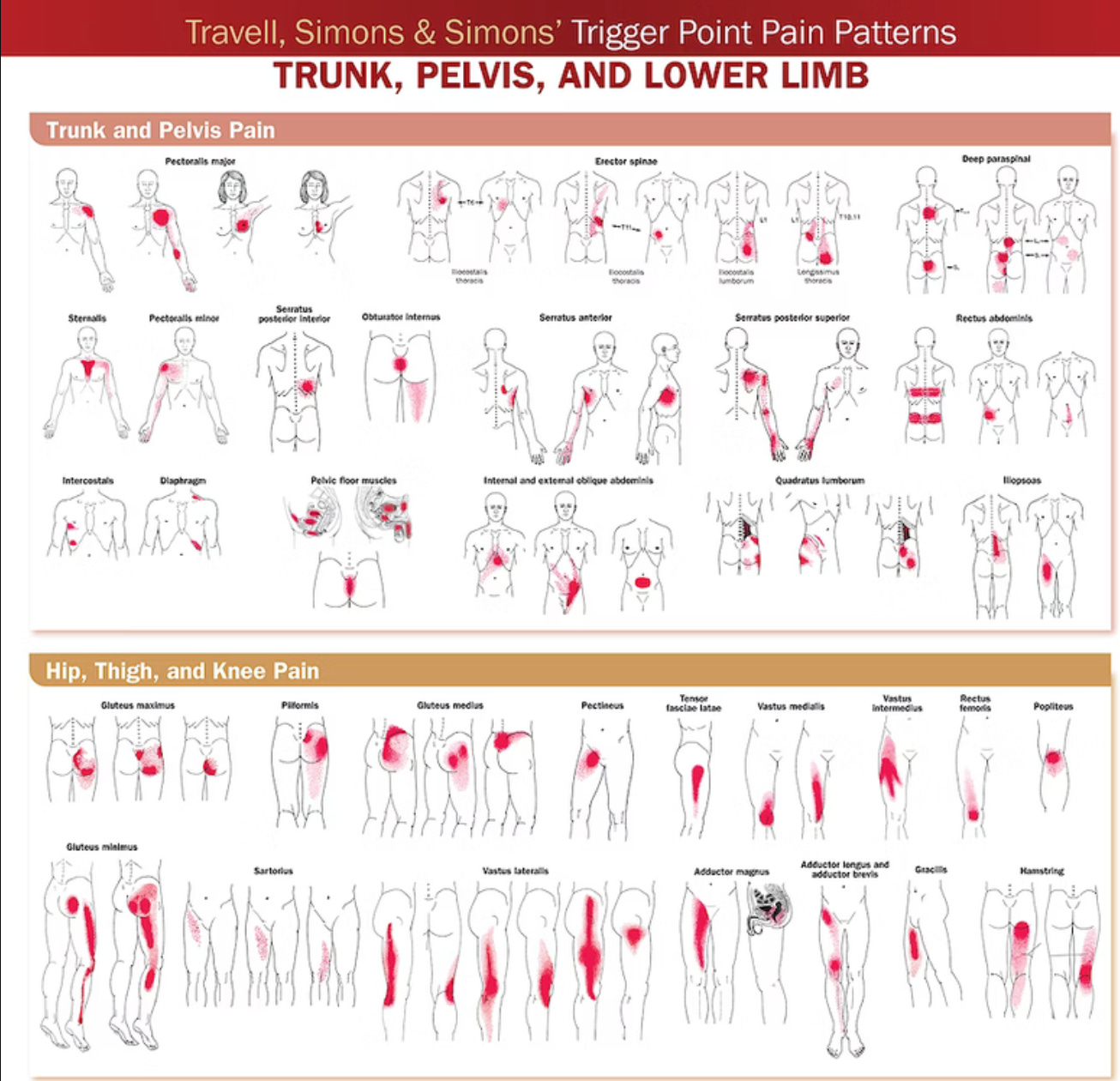
What the model captures correctly
Trigger points exist and they can be identified by trained clinicians. Jay Shah, a physical medicine and rehabilitation specialist developed a microdialysis technique to sample tissue chemistry directly from active trigger points in the upper trapezius. Shah was the first researcher to prove that the knots clinicians palpate are biochemically distinct from the surrounding tissue. The tissue at an active trigger point has inflammatory and pain-signaling chemicals: substance P (a neuropeptide that transmits pain signals), bradykinin (a pain-inducing peptide), calcitonin gene-related peptide (pain-signaling molecule), inflammatory cytokines – all elevated. Local pH runs acidic compared to the neutral tissue around it. Trigger points are inflamed, biochemically distressed regions of tissue.
It’s important to note that local intervention on a trigger point can disrupt the local biochemistry and produce relief. This applies both to skilled hands-on work (sustained pressure, myofascial release) and to injections (saline, lidocaine, corticosteroid).
But here is the problem. The pathology Travell and Simons were treating was located primarily in fascia rather than muscle. Their research predated the modern recognition of fascia as a distinct organ system, so they located the pathology in the tissue their era knew how to see. They were actually palpating and injecting fascia layered through and around the muscle, and Shah’s microdialysis captured the biochemistry of densified, inflamed fascia.