

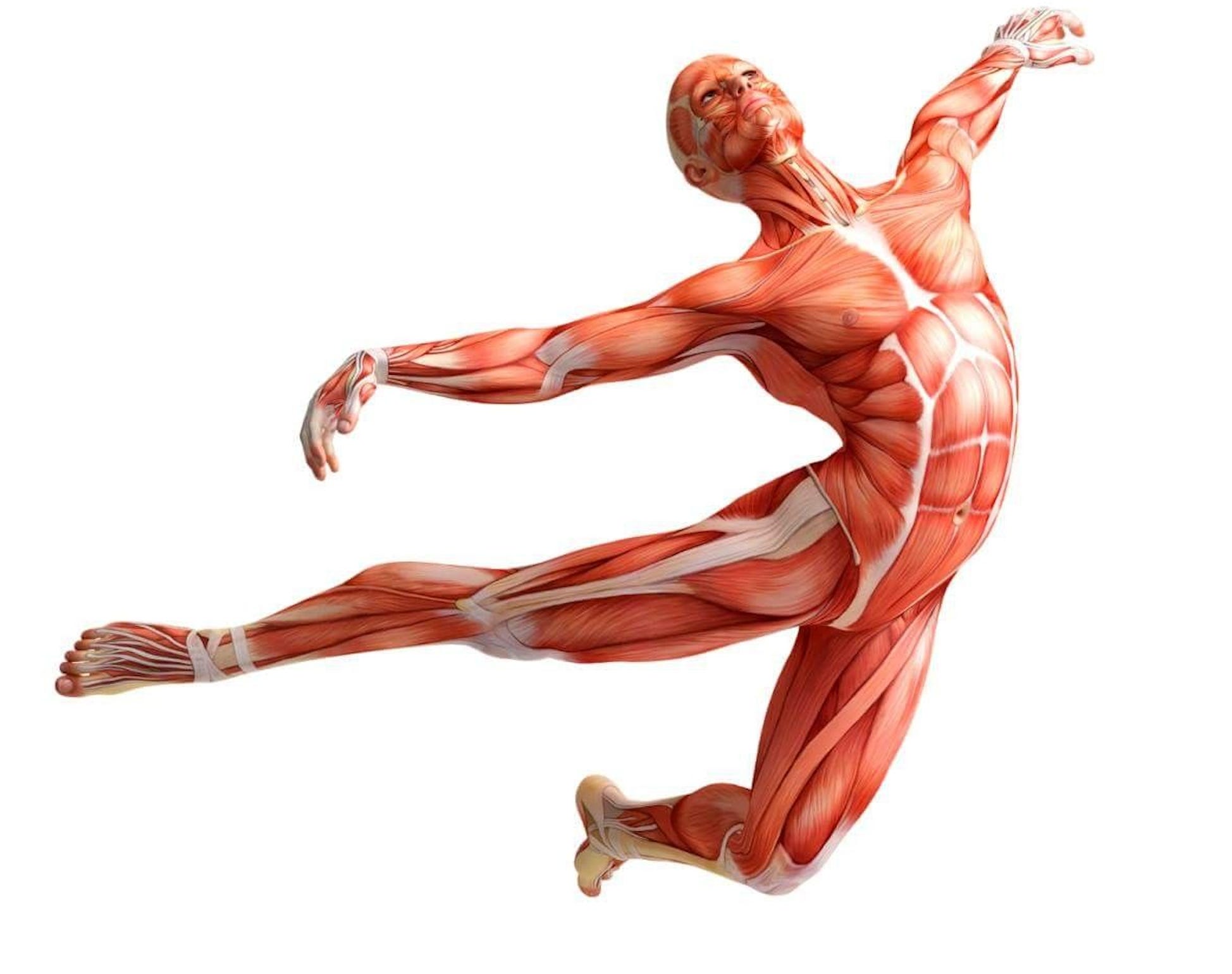
You are made of a material that generates electricity when you press on it. Every time you take a step, roll on a foam roller, or lean into a stretch, your collagen fibers convert that mechanical force into a small electrical field. It is a real phenomenon, governed by the laws of physics, and one reason every movement you perform on your fascia causes changes at the cellular level.
A lot of what has been taught about foam rolling, myofascial release, stretching and how it all works is wrong.
In this article I review the evidence for myofascial release techniques, static, dynamic and PNF stretching, active fascia training, percussion guns, and cupping. For each one, I will explain the mechanism and what to actually do.
Piezoelectric Collagen: The Bioelectric Effect
In 1957, two Japanese scientists, Eiichi Fukada and Iwao Yasuda, inserted a section of dry human femur between a pair of electrodes and pressed down on it. The femur produced a small voltage. No batteries, no outside power source; just the laws of physics. Seven years later, they did a similar experiment using collagen extracted from the Achilles tendons of oxen and horses. They also observed a voltage response, similar to what a piece of quartz crystal might produce.
Think of a hand-held lighter, the kind that makes a little spark when you push down on a button. The spark is generated by squeezing a piece of quartz crystal. When your collagen is squeezed or stretched, it will generate approximately the same amount of voltage, making it one of the strongest natural piezoelectric materials in the body.
But why does this happen? The collagen molecule is made up of long strands of individual amino acids strung together like links on a chain. Each individual amino acid has a slightly positive charge on one end and a slightly negative charge on the other, much like a tiny magnet. These chains are linked together by fairly weak chemical bonds. When the collagen is squeezed or stretched, these little magnets shift a little bit, generating voltage. Simply put: collagen is a natural piezoelectric material. When collagen is squeezed or stretched, it generates an electric field that you can measure. The size and polarity of that electric field depend on the direction and amount of squeeze or stretch.
For years, skeptics said this effect only showed up in dead or dried out tissue. But living tissue is wet, and that’s where it gets complicated. While collagen itself is piezoelectric, the water and charged particles flowing through tissue also create electricity. Water can dampen the piezoelectric signal you measure over a larger area of tissue, while electron microscopes show that there is electrical activity going on all around the collagen fibers. In a living system, the two signals get tangled up. Fascia loading does produce a real electrical response, but it is a combination of the collagen, the moving water, and the moving ions. It happens every time you take a step, every time your bones are loaded, every time your fascia is squeezed or stretched.
It is one of the physical mechanisms involved in Wolff’s Law, the principle that bone adapts its shape and density to the loads placed on it. It is also why astronauts lose bone in space even when they eat the same amount of calcium as on Earth. Remove the loading and you remove a major source of mechanical/electrical signaling to bone cells telling them they are still needed. The cells that build collagen (fibroblasts) can sense those small electric fields and respond to mechanical pressure through pressure-sensitive protein “doors” on their surface. Both signals travel together: the electrical signal is the shadow of the mechanical pressure, appearing at the same time and sensed by the very same cells that built the collagen in the first place.

This brings us back to the hydration piece I wrote last month because dehydrated and dense tissue won’t respond well to loading. Thyroid hormone controls the delivery of water into connective tissue; sodium drives intracellular water; bile flow promotes fat digestion, nutrient absorption, and mitochondrial energy. You can spend an hour a day foam rolling with very little result if the cells don’t have sufficient water, nutrients, or energy to remodel.
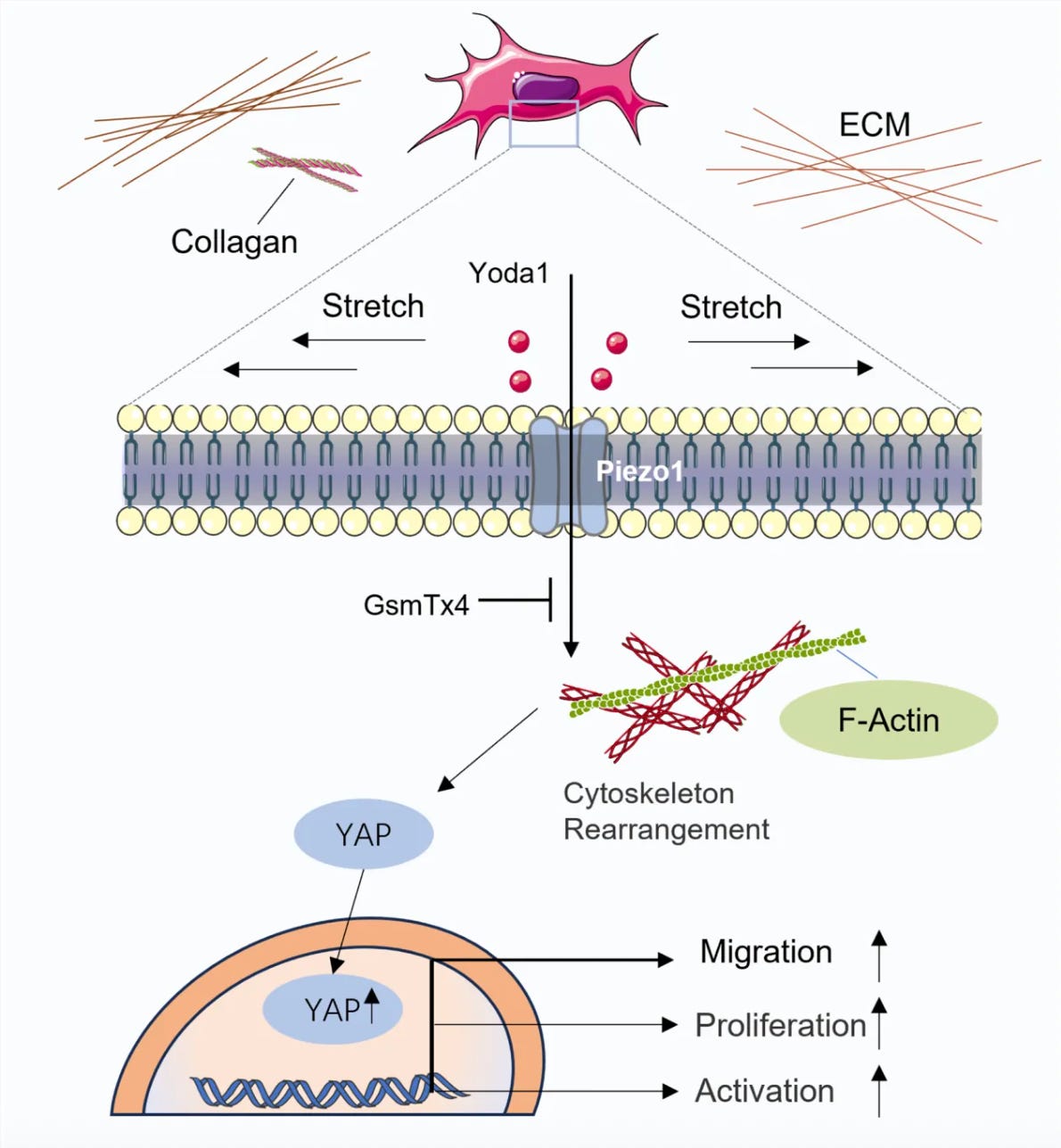
In addition to piezoelectricity, there are more recent studies that describe specific mechanosensors on the surface of cells that build collagen, and specialized fascia cells (fasciacytes). They have names like Piezo1 and TRPV4. They’re like doors on the outside of the cell, sensitive to pressure. Mechanical force presses on the door, and it opens, and calcium floods in. The influx of calcium is the message to the cell to produce new hyaluronic acid, the molecule that allows fascial layers to slide past one another. Whether the new hyaluronic acid is large and heavy or small and light dictates whether the tissue remains quiescent or undergoes a process of remodeling. This process is known as the Ca2+-Hyaluronan axis, or CHA, and a model was developed for it in 2025. Currently it’s the best theory we have for how fascia converts mechanical input into cellular-level action.
To put it simply, mechanical force on the collagen leads to an electrochemical response as well as a biochemical response involving calcium. Cells read these signals and modulate their behavior accordingly. That’s mechanotransduction in fascia: the tissue’s response to being loaded.
Mechanotransduction and Fluid Shifts
Helene Langevin at the University of Vermont has been investigating how connective tissue cells respond to stretching for two decades. The researchers in her lab extracted the loose connective tissue under the skin and stretched it by about a quarter of its relaxed length. Over the next 10 minutes to two hours, the cells making collagen changed shape. They became flat, the proteins within them rearranged, and even the nuclei in which their DNA lives were affected.
And then there’s fluid movement. Most fascia is water suspended in a solution of hyaluronic acid (the same molecule that cushions your joints and keeps your skin hydrated) and other similar sugar-water molecules. Prolonged pressing or slow shearing of fascia causes the fluid to shift. If you press and hold fascia in one place, the fluid shifts sideways. If you release, it flows back. The fluid carries dissolved nutrients with it and provides energy and mechanical stimulation to the cells. That’s one reason why slow, sustained pressure is more beneficial than quick rolling.
The third mechanism is thixotropy. The gelatinous material between cells in fascia gets more fluid when force is applied. Think of ketchup. It’s thick in the bottle but flows freely after shaking. It’s back to being thick after it sits for a while.
With constant mechanical stimulation, fascia becomes more liquid. In a resting state, it is more gel-like. That’s why fascia feels different after five minutes of slow manipulation than it did before.
All three of these things occur during any mechanical intervention: the cellular remodeling (which is what mechanotransduction refers to), fluid movement, and changes in the gelatinous state.