
Restoring the Pulse of Life - A Teleological Blueprint for the Body, Spirit, and Civilization
The Ultimate Answer to Everything


Part I — The Death Before Death
The Hidden Collapse
We are not merely dying - we are decomposing while alive.
The modern human has mastered survival yet lost the architecture of life.
We live longer, but not deeper. We accumulate comfort, but shed coherence.
Our biology drifts without mission; our culture decays while pretending to innovate.
This condition- silent, chronic, invisible - is autonecrosis: the self-dissolution of the living.
It is not sudden death, but a gradual surrender of regenerative intelligence.
Cells still divide, cities still function, individuals still perform but the inner teleology, the why, is gone.
The result is not catastrophe but corrosion.
Entropy disguised as civility.
Thanatos enthroned as reason.
The world runs on systems that no longer believe in life.
Genesis and Thanatos: Two Fundamental Forces
All of existence is a dialogue between two tendencies: Genesis and Thanatos.
Creation and destruction, order and decay, expansion and contraction.
In physics, this duality is known as negentropy versus entropy.
In biology, anabolism versus catabolism.
In the psyche, Eros versus the death-drive.
Life exists only when these opposites intertwine.
As Heraclitus wrote, “War is the father of all things.”
A healthy organism doesn’t seek to eliminate death; it integrates it.
Cells die (apoptosis) to make space for renewal. Old tissue yields to new growth.
Every breath is a tiny death, every heartbeat a miniature resurrection.
Balance is not stasis.
It’s a rhythmic tension between forces that would otherwise annihilate each other.
When the rhythm breaks - when death no longer serves life but begins to command it - the organism turns inward and starts consuming itself.
That is the moment the pulse of civilization begins to falter too.
Genesotony: The Rule of Creation
During the first half of life, creation reigns.
The child grows, the adult reproduces, the mind builds, the society expands.
The tension of Genesis – genesotony - dominates metabolism, thought, and behavior.
The organism is oriented toward outward motion: to explore, to mate, to construct, to teach.
This is not merely biological but metaphysical: it is the phase where the body and the spirit still share the same direction.
In this state, hormones support vigor; mitochondria amplify energy; the nervous system maintains renewal. Purpose and physiology are one circuit.
But purpose is not self-sustaining. It must be continuously fed with meaning.
When Eros- the creative impulse - is not evolved into higher forms after reproduction, the biological script runs out. The energy that once built new life has nowhere to go. It inverts.
The Onset of Autonecrosis
Autonecrosis begins at the exact moment when the organism stops being a participant in creation.
It doesn’t have to mean death, illness, or old age - it can start in a 25-year-old whose life has lost direction, whose actions no longer generate renewal.
The body, deprived of teleological coherence, falls out of rhythm with itself.
Metabolic tone drops. Repair slows. The immune system turns against its host.
Every chronic disease of civilization - cancer, atherosclerosis, neurodegeneration - is not just a mechanical failure, but a manifestation of meaning collapse.
Autonecrosis is not just dying; it is forgetting to regenerate.
Thanatocracy: When Death Becomes Policy
What happens when this forgetting spreads from individuals to institutions?
You get thanatocracy - the rule of death disguised as order.
Thanatocracy is not a dictatorship of a man but of a principle.
It governs by the logic of decay: efficiency without vitality, safety without creativity, existence without transcendence.
It appears as bureaucracy, over-medicalization, censorship of spirit, sterilization of art.
Its slogans are “manage,” “stabilize,” “sustain” - never “create,” “expand,” or “give birth.”
A thanatocratic culture praises longevity but fears passion.
It manufactures medication for depression while outlawing ecstasy.
It preaches equality but erases excellence.
It calls nihilism “realism,” and cynicism “wisdom.”
It produces comfort and kills meaning.
And humans, mistaking sedation for peace, accept it willingly.
Teleological Physiology: The Forgotten Science of Purpose
Modern biology pretends to be materialist, yet it is profoundly teleological in practice.
Every cell behaves as if it knows what to do.
DNA is not a blueprint - it’s a script for future action.
Metabolism is not a random chemical churn but a directed process aimed at maintaining coherence.
Physiologists like Claude Bernard and Walter Cannon recognized that the body is a goal-oriented system - constantly self-regulating to preserve internal purpose (homeostasis).
Aristotle would have called this entelechy - the “being-at-work-staying-itself.”
When purpose disappears, homeostasis collapses.
Biology descends into noise.
Thus the metaphysical and the medical merge:
To lose meaning is to lose metabolic coherence.
To lose coherence is to decay.
This is why the most powerful medicine is often not biochemical but teleological - to reawaken the organism’s reason to persist.
The Second Half of Life: Rebirth or Regression
Carl Jung observed that the second half of life is either a descent into bitterness or an ascent into wisdom.
He warned that those who fail to transform their reproductive energy into spiritual or creative generativity suffer regression: the libido turns inward and consumes the psyche.
This is autonecrosis on the psychic plane.
The eros that once built relationships now builds anxiety.
The force that could have mentored others curdles into envy or despair.
The ancient world knew this transition as initiation into elderhood. The post-reproductive were not discarded but sanctified as carriers of culture.
They embodied post-genital eros - life’s continuation through wisdom, art, and legacy.
Modern society abolished initiation.
We extended adolescence and pathologized maturity.
We idolize youth but produce no elders.
Without this transmutation, both body and society rot.
Spirit: The Axis of Eros
Spirit, in this framework, is not a ghost or belief system - it is the directional tension that gives matter its form.
It is what Viktor Frankl called the “will to meaning,” and Nietzsche the “will to power.”
It is the principle that makes the organism rise against entropy and assert its form against chaos.
When spirit weakens, biology follows.
Hormones lose rhythm, immunity loses discernment, consciousness loses hierarchy.
The same applies to culture: when collective spirit collapses, institutions become parodies of themselves - still structured, but hollowed of purpose.
Spirit gives orientation; biology gives execution; culture gives continuity.
Break one link, and life degrades into mechanical persistence.
The Cultural Mirror
A civilization is the outer body of a collective soul.
When that soul loses eros, the body (culture) enters autonecrosis.
Spengler saw this a century ago in The Decline of the West: cultures, like organisms, pass from spring to winter - from the creative to the mechanical.
When the symbols of renewal become museums, when religion turns into ethics and ethics into bureaucracy, death already rules.
We live in that winter now:
Art without transcendence, science without wonder, sexuality without fertility, politics without destiny.
This is cultural autonecrosis and it expresses itself through us.
Every act of cynicism, apathy, or self-betrayal we commit feeds it.
The Biological Cost of Cultural Death
The organism is not isolated from the cultural environment.
The nervous and endocrine systems respond to meaning as much as to matter.
Purpose modulates physiology; despair deregulates it.
Studies on loneliness, chronic stress, and nihilism show measurable suppression of immunity, mitochondrial dysfunction, and inflammatory states.
Despair is not abstract - it’s biochemical entropy.
When culture no longer offers meaning, the individual’s biology begins to mimic social decay.
The death of civilization becomes the death of the cell.
The Antidote: Re-Erosification
To reverse autonecrosis, we must restore eros - the will toward creation, connection, and beauty.
This restoration is not sentimental. It requires a teleological re-education:
Learning to perceive the body not as machinery but as a mission.
Learning to perceive work not as transaction but as creation.
Learning to perceive death not as failure but as fulfillment of purpose.
Eros is the unifying field that keeps the molecular, the personal, and the cultural alive.
It is what the Greeks called psyche - the breath of life itself.
Without it, biology becomes bookkeeping, philosophy becomes cynicism, and art becomes marketing.
Re-erosification means re-sacralizing existence - seeing in every act, every relationship, every bodily process, a movement toward renewal.
Beyond Survival: The Rise of Biocracy
If thanatocracy is the rule of death, biocracy is the rule of life - the alignment of all systems (biological, spiritual, cultural) toward regeneration.
A biocratic society would measure success not by GDP or lifespan but by generativity:
How much life, meaning, and coherence does each structure create?
Biocracy begins with individuals who refuse to live mechanically.
Who eat with awareness, think with purpose, and act with creative intensity.
Who transform comfort into contribution.
Who embody eros in daily motion.
This is not ideology - it’s survival at a higher octave.
The Call to War
Entropy is patient, persuasive, and polite.
It whispers that rest is enough, that passion is dangerous, that striving is futile.
It wants you docile, distracted, and mildly comfortable so that death may rule unopposed.
Resisting thanatocracy requires war - first within yourself.
Every moment of vitality, courage, and creation is an act of defiance.
Every time you choose to think, love, build, or learn, you overthrow a little piece of death’s empire.
Life is not peace; it is revolt.
Creation is not leisure; it is war against nothingness.
To live fully is to declare war on entropy - daily, physically, spiritually, culturally.
Part II — The Resurrection of Purpose
Nietzsche: The Physiology of Spirit
Nietzsche saw clearly that decadence begins when the instinct for growth turns inward.
In The Will to Power he defined sickness as a loss of the ability to organize one’s drives.
When life can no longer command itself, it decays.
That is autonecrosis in philosophical language.
The healthy individual is not “balanced” but hierarchically integrated - his instincts serve a single commanding purpose.
When that purpose disappears, the drives collide; the organism eats itself.
Nietzsche called this “ressentiment”: the physiology of a spirit that can no longer act, only react.
A culture behaves the same way.
When it no longer creates values, it begins to moralize, regulate, and sterilize.
Law replaces vision, sentiment replaces strength, and the priest of comfort replaces the artist of life.
The result is a slow-motion suicide disguised as civility.
To escape, Nietzsche offered no therapy but transvaluation - the forging of new meaning through creative power.
Only the individual who creates his own order can resist the pull of collective decay.
He must become his own physician, diagnosing and reshaping the instincts that civilization has flattened.
Berdyaev: Freedom as Creative Destiny
Where Nietzsche spoke as a hammer, Nikolai Berdyaev spoke as a prophet.
For him, the central drama of existence was the tension between necessity and creativity.
Necessity is the law of matter, of repetition, of mechanical being - Thanatos’ kingdom.
Creativity is the revelation of spirit through freedom - Genesis manifesting in history.
When man forgets that he is called to create, he becomes a function of nature and society.
He ceases to be image of the divine and becomes an instrument of process.
That is the deepest form of slavery: not political but ontological.
Berdyaev warned that industrial civilization, with its cult of efficiency, was converting humanity into a species of obedient machines.
He saw this as the triumph of necessity over spirit - exactly what we now call thanatocracy.
His antidote was what he called “the creativity of love” - an eros of spirit, where each act of creation, however small, participates in divine renewal.
To create, in Berdyaev’s sense, is to liberate being from mechanical repetition.
This liberation is the same biological act we observe in healthy tissue: differentiation, renewal, metamorphosis.
Freedom is therefore physiological.
Without creative freedom, the cells of culture die.
Jung: The Transmutation of Libido
Carl Jung completed what both Nietzsche and Berdyaev began - he mapped the mechanics of renewal inside the psyche.
He noticed that the energy which fuels sexuality in youth can, if consciously redirected, become the energy of wisdom and creation.
If it is not redirected, it turns toxic.
Un-transmuted libido becomes neurosis; un-integrated eros becomes anxiety, addiction, or obsession.
That is psychological autonecrosis: libido consuming itself.
Jung’s process of individuation - the integration of the conscious and unconscious - was not just therapy but alchemy.
It mirrored biological regeneration: the old ego must die so that a higher order can emerge.
Each successful transformation keeps Thanatos in service of Genesis.
Societies, too, require individuation.
A culture that refuses to face its shadow - its envy, hypocrisy, dependence - projects them outward and disintegrates.
Civilization collapses not from poverty but from psychic disintegration.
Spengler: The Autopsy of Civilization
Oswald Spengler wrote The Decline of the West as if dissecting a corpse.
He saw civilizations as organisms: born, maturing, ossifying, dying.
Every culture begins as a soul and ends as an intellect.
It moves from organic unity to mechanical expansion.
In the youth of a civilization, art, faith, and science serve a single mythic vision.
In its old age, they fragment into specializations, statistics, and bureaucracy.
The living culture becomes a civilization - a shell animated by habit, no longer by purpose.
Spengler’s description of the late West is a textbook case of thanatocracy:
a society addicted to management, detached from the sacred, allergic to creation.
Its citizens confuse motion with progress and entertainment with meaning.
Yet Spengler left one loophole: the possibility of a new spring arising from individuals who rediscover the mythic core of life.
When even one human being re-ignites eros, the cycle can restart.
Civilization can be reborn from within the ruins.
The Teleological Field: Body, Spirit, Culture
Bringing these visions together yields a simple but radical model.
Life is a teleological field composed of three layers:
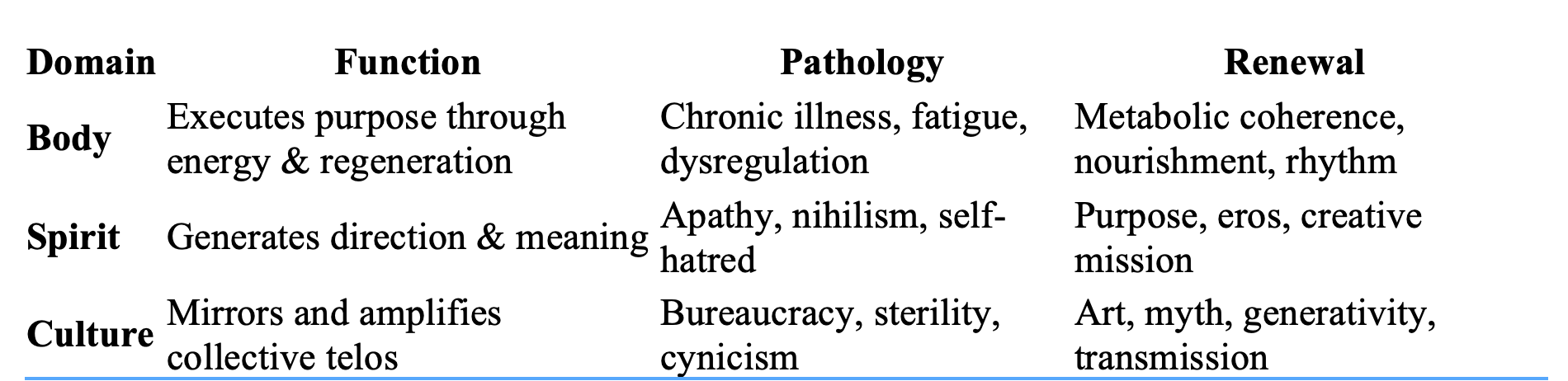
These layers are not separate; they vibrate together.
When one weakens, all decay.
Autonecrosis begins in the spirit, spreads through the body, and metastasizes into culture.
Restoration must therefore proceed in reverse order:
Re-spiritualize the culture, re-animate the individual, and the body will remember how to live.
Biocratic Ethics: The Discipline of Life
The opposite of thanatocracy is biocracy - the rule of life.
A biocratic person governs himself by laws that increase vitality across all scales.
The Four Laws of Biocracy
Law of Direction – Every act must serve a purpose greater than itself.
Random motion equals entropy; directed motion equals growth.Law of Exchange – Life thrives on giving and receiving energy.
Hoarding kills flow; generosity renews.Law of Hierarchy – The higher must govern the lower.
Spirit commands matter; will commands impulse. When this order inverts, chaos follows.Law of Repetition – Renewal requires rhythm.
Sleep, nourishment, worship, work - all must recur like heartbeats.
Stagnation comes from broken cadence.
To live biocratically is to become your own ecosystem, to synchronize your microcosm with the macrocosm of creation.
The Practice of Renewal
a. Biological Discipline
Sun & Sleep: Align circadian rhythm with natural light; the endocrine system is a clock wound by dawn.
Nourishment: Eat for energy stability, not ideology - food that signals safety to the cell: warm, mineral-rich, alive.
Movement: Train not to exhaust but to express strength; muscle is moral structure made visible.
Restoration: Alternate intensity with stillness; regeneration is cyclic, not linear.
b. Spiritual Discipline
Silence: Daily intervals of non-input; the nervous system recalibrates meaning in quiet.
Study: Read creators, not commentators; feed eros with greatness.
Ritual: Re-sacralize the ordinary - light, meal, conversation. Repetition becomes prayer.
Creation: Produce something daily that did not exist before: a paragraph, melody, design, or act of mercy.
c. Cultural Discipline
Transmission: Teach what you know. Knowledge withheld stagnates.
Aesthetics: Surround yourself with order and beauty; environment trains perception.
Community: Join or form circles that build, not complain. Culture is created in micro-cells.
Resistance: Withdraw attention from institutions that worship decay. Starve thanatocracy of energy.
Each of these acts rewrites physiology. Meaning is biochemical.
The Re-Erotization of Existence
Autonecrosis thrives on shame.
Modern people are taught to distrust desire, to sterilize passion, to confuse sensuality with sin.
But eros - properly understood - is the engine of all creation.
Eros is not merely sex; it is the impulse toward union, beauty, and continuity.
It powers the artist’s brush, the scientist’s curiosity, the mother’s tenderness, the saint’s devotion.
To suppress it is to neuter the universe.
The biocratic human honors eros as sacred fire and disciplines it through purpose.
When desire serves creation, it becomes holy.
When desire is denied or diffused, it mutates into addiction and fatigue.
Therefore: never apologize for your vitality.
Redirect it, refine it, but never extinguish it.
The suppression of eros is the first commandment of every thanatocracy.
The Ethics of Strength
The new morality is not about compliance but contribution.
Weakness is not virtue, and strength is not sin.
Strength - of body, mind, or spirit - is life defending itself.
Nietzsche’s “Übermensch” was not a tyrant but a healer, one whose overflow of energy regenerates the world around him.
The weak consume; the strong create.
The goal is not domination but super-abundance.
To live ethically is to increase the total vitality of existence:
to leave every system you touch - human, ecological, artistic - more alive than you found it.
That is the sole moral law of biocracy.
Re-Mythologizing the World
Culture dies when myth dies.
Myth is not fiction; it is the narrative architecture through which the psyche experiences meaning.
Every civilization is built on a story that tells its people why they exist.
Our age has none. It has data, not destiny. Information, not initiation.
The new myth must re-unite body, spirit, and cosmos.
It must say again: to live is sacred, to create is holy, to die fulfilled is triumph.
Art must return to metaphysics; science must return to wonder; philosophy must return to awe.
Without myth, knowledge becomes sterile technique.
With myth, technique becomes ritual.
Toward a Culture of Elders
One measure of a society’s health is how it treats its post-reproductive members.
Animals without elders repeat mistakes. Cultures without elders repeat wars.
In a biocracy, the elder is not obsolete but initiatory - the bridge between past and future.
They transmit pattern, myth, and restraint.
They embody eros transformed into wisdom.
To restore this role is to re-stitch the torn fabric between youth and age, creation and reflection.
Without it, both generations decay: the young burn out, the old fade away.
The Political Dimension of Thanatocracy
Thanatocracy sustains itself through fear.
Fear of illness, of poverty, of social rejection.
It convinces citizens that safety is the highest good, thereby erasing the appetite for greatness.
Its true enemy is not rebellion but vitality. A healthy, purposeful population is ungovernable by fear.
Biocracy therefore begins with self-governance. The more individuals master their own energies, the less they need external control. The highest political act is personal coherence.
The Path of Re-Creation
Regeneration must occur simultaneously on all planes:
Physiological Renewal – restore metabolic rhythm.
Psychological Renewal – integrate shadow and rediscover eros.
Cultural Renewal – rebuild communities of meaning.
Mythic Renewal – articulate a narrative worthy of devotion.
Each step feeds the others.
Energy without purpose burns out; purpose without energy dries up.
Only their union produces civilization.
The Return of the Sacred Body
For centuries the West treated the body as inferior to spirit.
That dualism is itself a symptom of decay.
The body is the altar of meaning - matter made responsive to purpose.
To inhabit it consciously is an act of worship.
To poison it, neglect it, or shame it is blasphemy against life.
Every gesture, breath, and heartbeat is a liturgy of existence.
When we move with awareness, we remind matter of its mission.
Thus the biocratic revolution begins not in parliaments but in posture, diet, sunlight, breath.
The sacred body is the first temple of a resurrected world.
Part III — The Architecture of Biocracy
From Analysis to Architecture
Understanding decay is not enough; diagnosis without design is just despair.
Every age that collapses under its own weight does so because it can no longer imagine form.
To end the rule of death, we must build structures that obey the logic of life.
Biocracy is not a slogan. It is a design principle: organize everything - body, mind, economy, art, and governance - around regeneration rather than extraction.
Medicine of Purpose
Modern medicine treats the body as a machine that occasionally breaks; the biocratic medicine treats it as a meaning-making field that occasionally forgets its direction.
Principles of Biocratic Healing
Teleological Diagnosis – Ask “Why has this tissue lost its purpose?” before “What drug will suppress it?”
Restorative Rhythm – Circadian alignment, nutrition timed to light, movement tied to breath.
Energy before Chemistry – Support mitochondrial function, warmth, and circulation; chemistry follows current.
Meaning as Immunity – A patient with a reason to live reorganizes physiology faster than any molecule can.
Hospitals should look more like monasteries of renewal - places where light, food, and music remind cells what existence feels like when it matters.
Education for Eros
A thanatocratic school produces compliant specialists.
A biocratic school produces initiated creators.
Children must be taught rhythm before information, wonder before analysis, embodiment before abstraction. Every curriculum should weave:
Craft - to ground intellect in matter.
Story - to link knowledge with destiny.
Silence - to form attention.
Service - to give eros a social direction.
Education should not fill heads but ignite centers of purpose.
Economy as Metabolism
An economy mirrors cellular life: production, exchange, elimination, renewal.
Under thanatocracy, money circulates like stagnant lymph - hoarded, toxic, un-oxygenated.
Biocratic economics asks one question: Does this transaction create more life than it destroys?
Enterprises that regenerate soil, community, craftsmanship, or intellect are rewarded; those that extract without renewal lose legitimacy.
Growth is redefined as complexity × vitality, not volume × speed.
Capital becomes caloric again: energy for creation, not accumulation.
Art and Aesthetics of Life
Art once crowned temples; now it decorates lobbies.
Its task is not distraction but remembrance - the re-enchantment of matter.
A civilization that no longer produces beauty is confessing its death wish.
The biocratic artist restores the sacred by revealing order inside chaos, eros inside decay.
Architecture must breathe again: light, proportion, warmth.
Music must re-teach rhythm to nervous systems numbed by noise.
Literature must resurrect archetype and myth, not irony and despair.
Art is the immune system of culture. Its collapse precedes every epidemic of meaninglessness.
The Politics of Renewal
Biocracy is post-ideological.
It is neither left nor right - it is vertical: ascending toward greater coherence.
A biocratic polity governs by vitality metrics: fertility, creativity, mental health, ecological balance.
Policies are judged not by profit or popularity but by whether they increase the life-capacity of citizens.
The leader is not a manager but a conductor, coordinating energies so that each class, trade, and region vibrates in harmony.
Citizenship itself becomes initiatory: rights are paired with regenerative duties - creation, mentorship, stewardship.
The Spiritual Infrastructure
Religion decayed when it abandoned incarnation; science decayed when it abandoned mystery.
Biocracy unites them: spirit is pattern; matter is its echo.
Temples of the future will not ask what you believe but what you create.
Ritual will no longer be submission but synchronization - breath, sound, light, shared rhythm.
The spiritual hierarchy is simple:
Awareness - know that you are alive.
Gratitude - affirm that life is good.
Responsibility - act as if life depends on you.
When practiced daily, these three transform physiology as deeply as any sacrament.
The Individual as Micro-Civilization
Every person is a city of cells, a parliament of drives, a cathedral of meanings.
To govern oneself biocratically is to align these internal institutions.
Internal Ministries
Metabolism (Industry) - keep energy flowing, remove waste.
Emotion (Foreign Affairs) - translate external events into internal adaptation.
Imagination (Culture) - generate symbols that orient desire.
Will (Executive) - decide direction and allocate energy.
Self-government precedes civilization; every coherent human adds coherence to the collective field.
Rituals of Resistance
To live under thanatocracy is to be surrounded by slow poison: noise, anxiety, irony, fragmentation.
Resistance requires ritual armor - habits that re-align you daily with Genesis.
Dawn Discipline: step into natural light within minutes of waking; remind the hypothalamus that the world is still worth rising for.
Creative Hour: one uninterrupted block for generative work - writing, building, composing.
Embodied Prayer: slow breathing, posture correction, eye contact; physical affirmation of presence.
Evening Withdrawal: cease consumption; digest experience instead of media.
These rituals are not lifestyle tweaks - they are weapons in the war for vitality.
Legacy as Antidote to Death
The ultimate vaccine against autonecrosis is legacy - the act of transmitting life beyond one’s lifespan.
Legacy can take many forms: a child, a masterpiece, a discovery, a healed relationship, a re-greened field. All are extensions of eros through time.
Every living system wants continuity. When humans forget this, their biology follows suit; fertility drops, telomeres shorten, despair spreads.
Legacy restores the organism’s reason to regenerate.
To work for something that will outlive you is to tell your cells: continue.
Metrics of Vital Civilization
If a civilization wanted to measure its health truthfully, it would track:
Birth-to-Creation Ratio: births + original works per capita.
Meaning Density: proportion of population engaged in generative vs. reactive labor.
Rhythmic Integrity: average alignment between light cycles, work cycles, and rest.
Aesthetic Saturation: percentage of public space devoted to beauty and quiet.
Elder Transmission Index: intergenerational mentorship frequency.
These metrics would reveal instantly whether Genesis or Thanatos holds power.
Technology and the Re-Humanization of Machines
Technology itself is neutral, it follows the hand that guides it.
Under thanatocracy it accelerates entropy; under biocracy it extends creation.
The goal is not to abandon machines but to humanize them:
interfaces that preserve attention, algorithms that reward depth, AI that amplifies wisdom instead of addiction.
When tools serve renewal, they become instruments of life; when life serves tools, extinction begins.
The Stages of Resurrection
Awakening: recognition of self-decay.
Cleansing: removal of habits that feed entropy.
Alignment: body and spirit placed in rhythmic coherence.
Creation: daily generative acts rebuild feedback between matter and meaning.
Transmission: knowledge and energy shared; culture re-gains continuity.
Every human, every community, every civilization must pass through these five in order.
Skip one, and death returns.
The New Covenant of Life
The age of nihilism ends when people remember that existence is a privilege, not a punishment.
The covenant of life is simple:
You are allowed to live, therefore you are obliged to create.
Creation is worship.
Maintenance is morality.
Regeneration is justice.
To break the covenant - to exist without creation - is the only true sin against life.
The Reign of Life
Picture a civilization that has completed the passage:
Cities designed like organisms—breathing, circulating, resting.
Education teaching children the rhythm of cosmos and cell.
Medicine guided by purpose, not patent.
Elders honored as living libraries.
Technology that extends attention, not addiction.
Citizens whose daily work increases the amount of order, beauty, and love on Earth.
That is not utopia; it is biology restored to consciousness.
The reign of life begins the moment a single human refuses to live half-dead.
Final Admonition
Death will always exist; but the worship of death is a choice.
Thanatocracy collapses the day enough people choose otherwise.
Feed your body truth, your spirit fire, your culture form.
Let every act, word, and gesture add energy to the world.
Refuse irony. Refuse apathy. Refuse the comfort that kills.
Be a furnace of coherence in an age of collapse.
Where you walk, life should grow behind you.
Because the ultimate law of existence is still what it was in the beginning:
Genesis must rule. Thanatos must serve.
Only just reading this now! Wow this is an incredible, thought provoking essay ❤️🙏
Lots of powerful messages, thank you <3