
Seven Metabolic Foundations to Help Autistic Children Thrive. New Frontiers.
When the Energy Grid Flickers: Autism, Mitochondria, and the Metabolic Language of Connection


Every living cell translates energy into signal. The pulse of metabolism - how efficiently oxygen and nutrients become usable fuel - dictates how everything else behaves: the immune system, the brain, even the personality that emerges from it.
When that conversion falters, the entire system begins to speak a different language -slower, quieter, more guarded. It pulls back from the world to preserve what little energy remains. What we call “withdrawal” is often just the body’s way of saying: I can’t afford this conversation right now.
Autism has long been described as a “neurodevelopmental disorder,” but the new paper in Cell Metabolism (“Mitochondrial dysfunction reveals H₂S-mediated synaptic sulfhydration as a potential mechanism for autism-associated social defects”) again shows that the story begins far below the level of thoughts or circuits.
It begins in the mitochondria - the cell’s energy grid.
When the Power Plants Falter
Mitochondria do more than generate ATP. They coordinate redox balance, detoxify reactive oxygen species, and help manage sulfur chemistry.
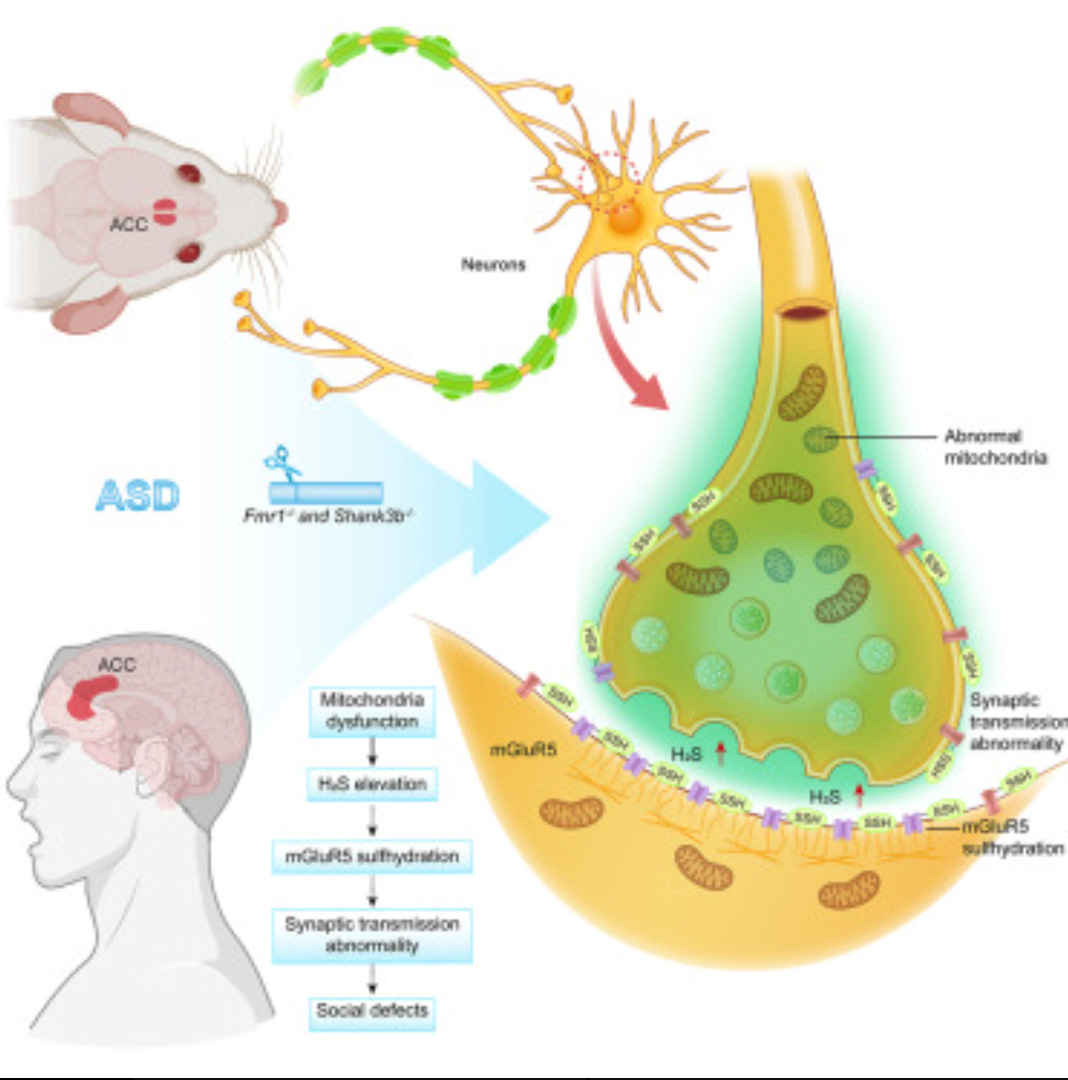
In the study, researchers examined two classic genetic mouse models of autism - Shank3b-/- and Fmr1-/y - and found the same underlying event: the mitochondria in the anterior cingulate cortex, a region that modulates social behavior, were sluggish and fragmented.
When energy flow through mitochondria slowed, another pathway surged to compensate: hydrogen sulfide (H₂S) production.
H₂S is a gas normally used for subtle signaling. It fine-tunes metabolism and protects against oxidative stress. But in excess it becomes disruptive. Too much H₂S triggers sulfhydration, a chemical process that tacks an extra sulfur atom onto cysteine residues of proteins. Think of it as a sticky film that changes how proteins fold and respond.
One of its major targets was mGluR5, a glutamate receptor that shapes how neurons talk to each other. When mGluR5 became over-sulfhydrated, synaptic signaling lost precision; neuronal messages blurred.
The behavioral result in mice looked uncannily human: social withdrawal, poor communication, and repetitive self-stimulation. When researchers lowered H₂S - either by dialing down the enzyme CBS (cystathionine β-synthase) that makes it or by feeding a diet with reduced sulfur amino acids - the mice re-engaged socially. Energy was restored, and so was connection.
From Gas to Behavior: The Bridge Between Metabolism and Mind
This cascade: mitochondrial failure -> H₂S buildup -> synaptic distortion -> social change translates chemistry directly into behavior. It reframes autism not as a static wiring defect but as an energetic state.
Different genetic or environmental insults may lead to the same metabolic bottleneck: when the power grid can’t meet the brain’s enormous energy demand, the system defaults into protection mode.
Mitochondria do not merely fuel neurons; they choreograph them.
Every thought, every act of social curiosity, is an energy transaction.
When energy becomes unpredictable, the nervous system reduces exposure - less exploration, fewer social exchanges, more repetitive patterns that guarantee internal stability.
What looks like a social deficit may in fact be an energetic defense.
The Metabolic Child: Energy Before Experience
Early development is the most energy-intensive phase of life. Infants triple their brain size in a few years; their mitochondria must learn rhythm before cognition can even begin. Each feeding, nap, and light cue trains the circadian and metabolic clocks. Disturb that rhythm through infection, inflammation, malnutrition, environmental toxins, or chronic overstimulation and the orchestration falters.
The “autistic” behaviors that later emerge can be seen as expressions of metabolic fragility.
A child whose energy system is unstable may seek sameness because unpredictability costs ATP.
They may avoid eye contact not from indifference but because the visual-social interface is metabolically expensive. The body economizes to survive.
Understanding this changes the moral frame: the child is not broken, but conserving.
The task of care becomes re-establishing metabolic safety rather than forcing performance.
Supporting Early Metabolic Resilience. 7 Principles.
The Cell Metabolism paper doesn’t offer therapies, but it clarifies leverage points - ways to sustain the biological conditions under which communication can grow.
Below are principles drawn from the logic of the data.
1. Rhythm and predictability.
Mitochondria anticipate demand. Regular light-dark cycles, consistent feeding times, and stable sleep protect the enzymes that govern redox balance. A chaotic schedule is an energetic stressor.
2. Adequate, steady fuel.
Infants and children depend heavily on glucose oxidation; prolonged fasting or extreme diets strain mitochondria. Frequent, nutrient-dense meals keep ATP production steady and prevent the redox swings that overactivate H₂S pathways.
3. Balanced protein sources.
Sulfur amino acids - methionine and cysteine - are essential, but when energy metabolism slows they can flood the trans-sulfuration pathway. Varied protein sources and sufficient B-vitamins (B6, B12, folate, riboflavin) help regulate that flow without depletion.
4. Micronutrient sufficiency.
Magnesium, zinc, copper, selenium, and manganese are co-factors in mitochondrial and antioxidant enzymes. Deficiency magnifies oxidative stress and H₂S dysregulation.
5. Redox balance and light exposure.
Natural daylight anchors circadian oscillators in mitochondria and enhances NAD⁺/NADH cycling. Sleep in darkness completes the redox reset. Artificial light at night, chronic sleep loss, or inflammatory stress all erode that rhythm.
6. Warmth and sensory moderation.
Cold, noise, and overstimulation increase metabolic cost. Warm, predictable sensory environments allow energy to be invested in growth rather than defense.
7. Emotional co-regulation.
A caregiver’s calm physiology acts as an external buffer. Lowered cortisol and steady breathing in the adult entrain the infant’s own metabolic tempo. Connection begins as shared respiration before it becomes language.
Each of these principles guards the same thing the study identified: the integrity of mitochondrial signaling. Protect that, and sulfur chemistry, neurotransmission, and social engagement follow.
Why This Matters Beyond Autism
The sulfur and energy logic identified here may apply far beyond autism: to fatigue syndromes, anxiety states, even neurodegeneration.
Whenever metabolism falters, communication within and between cells becomes distorted.
Our species’ social intelligence may simply be the biological luxury of abundant, well-regulated energy. Lose that abundance, and connection dims.
Re-imagining Intervention
The mainstream view looks for genetic fixes or behavioral training; the metabolic view looks for conditions that let the body resume its own patterning. This doesn’t mean discarding behavioral therapies or medication where necessary, but recognizing that none will hold if the cell’s energy system remains disoriented.
Healing, in this frame, begins with energy literacy, with learning what helps the organism feel energetically safe enough to engage.
The new Cell Metabolism paper makes the invisible visible: a social disorder traced back to a sulfur molecule on a receptor protein. Yet the lesson is poetic as much as chemical.
Every level of life from mitochondria to families runs on the same rule: coherence of energy flow determines the quality of communication.
When the grid flickers, conversation between cells or between people breaks down.
When the grid stabilizes, connection returns effortlessly.
Understanding autism through that lens doesn’t reduce it; it dignifies it.
It reminds us that behavior is the outer echo of metabolism, and that repairing connection, whether cellular or human, begins not in the brain but in the body’s quiet physics of energy.
Couldn't agree more. That line, 'What we call withdrawal is often just the body’s way of saying: I can’t afford this conversation right now,' is incredibly profound. It perfectly highlights how deeply our fundamental energy systems dictate everything, even complex social behaviors. This reframing is essetial.
This is incredible. I normally don’t leave comments but just wanted to let you know I’ll be returning to this often as I raise my two daughters!