

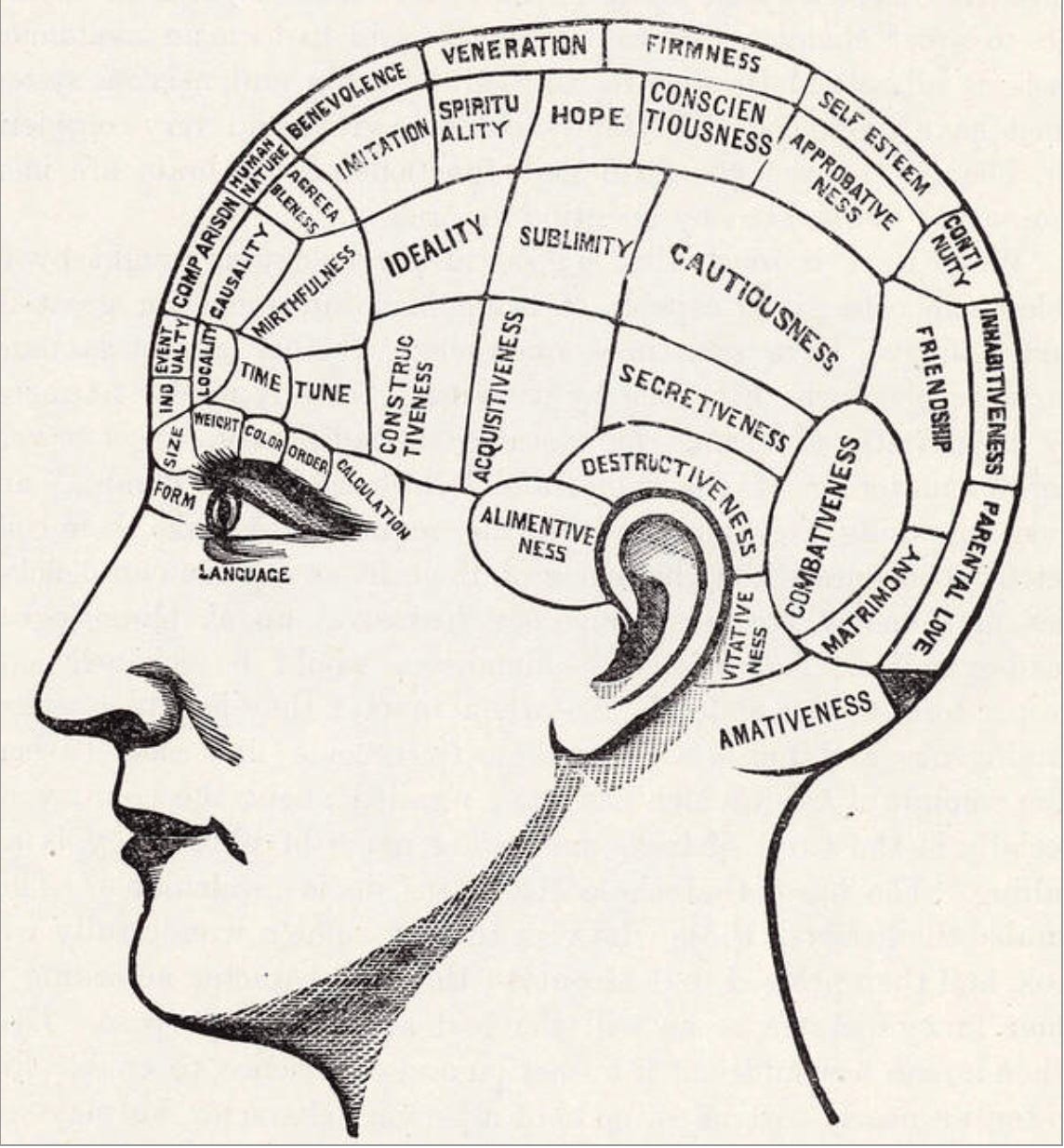
A few weeks ago, I began working on an article at around ten on a Sunday morning. I was reading research papers, tracing citations, comparing anatomical drawings, taking notes, forming theories, revising them, and seeing how they held up against the evidence.
When I next noticed the time, it was 6pm.
I hadn’t eaten. I’d barely stirred from my seat. (I know, I know this isn’t the best example of healthy behavior). Eight hours had passed, but it felt like one.
I’ve had this sort of experience before, mostly when I used to play the piano. I’d get so caught up in the music that the world would disappear. But I was surprised to discover that I could also experience it years later while doing something completely different. I was looking up facts, drawing connections, and solving problems.
It was hard work, but it didn’t feel like I was actively pushing myself from one thought to the next.
Psychologists call this experience flow. Neuroscientists have put forward a hypothesis called transient hypofrontality.
Flow isn’t just deep focus

‘Flow’ has become a catch-all term, now often applied to any time someone spends 20 minutes enjoying an activity without checking their phone. But the original definition was narrower.
In flow, your attention is wholly absorbed by the activity at hand. You act without thinking about it. You lose your sense of self. You feel in control even though you’re not consciously governing each detail. You might lose track of time altogether, or it might seem to stretch and shrink unpredictably.
There must be some sort of tension between the difficulty of a task and the level of skill required to perform it. It must be engaging enough to capture your full attention, but not so hard that it overwhelms you. Having clear goals and receiving immediate feedback also increase the chances of entering flow. The pianist knows right away whether a passage works, the climber feels the impact of their next move, the researcher discovers whether their hypotheses hold true. These factors can increase the likelihood of flow, but don’t necessarily guarantee it.
The most interesting part, however, is that flow requires focus without focusing on the focus itself.
Transient hypofrontality
Arne Dietrich, a neuroscientist, suggested that the experience of flow could depend on a short-term reduction in certain prefrontal processes. The prefrontal cortex is crucial for many activities related to executive functions, such as planning, working memory, inhibition of inappropriate responses and self-monitoring.
Dietrich didn’t argue that the entire prefrontal cortex would switch off; rather, he suggested that the brain may quiet some forms of conscious analysis and metacognition under certain conditions. That would explain why it’s possible to excel at something even when you’re not fully aware of what you’re doing, how you’re feeling or what time it is. He called it transient hypofrontality.
If you think about it, his theory seems intuitively right. In a state of flow, your internal monologue goes away. There’s no narration as you go about making choices. Musicians or athletes aren’t issuing individual instructions to each part of their body. They move before they have time to do the math.
Yet brain imaging hasn’t yet offered straightforward evidence that flow involves turning off the prefrontal cortex completely. One study tried to trigger flow in an MRI scanner by having people answer arithmetic problems whose difficulty shifted based on their performance. They found that flow led to greater activation in the inferior frontal cortex (linked to managing tasks and ignoring irrelevant information), the anterior insula (which evaluates what is relevant at a given moment), the basal ganglia (which select actions and underpin procedural learning), and parts of the midbrain that regulate arousal and reward.
At the same time, there was reduced activity in the medial prefrontal cortex and posterior cingulate cortex (both linked to self-monitoring and narrative identity), as well as some regions of the medial temporal lobe, including the amygdala (responsible for fear and threat, so yes, this area also quiets down!). In other words, the brain networks required for maintaining focus became more active, while those involved in monitoring yourself, your feelings, and the possibility that something might go wrong became less active.
That is far more interesting than the idea of a frontal lobe shutdown. The scientist cannot lose their ability to exercise executive control: they must still keep their question in mind, assess the relevance of available information, consider various explanations, spot contradictions, etc. The Formula 1 driver cannot forget their strategy. The surgeon cannot stop paying attention to what they’re doing.
What can go quiet is a form of control, the part of the mind that constantly comes in to check up on you. Am I doing well? What if I make a mistake? How long have I been at this? What are people going to think when they see the result? Should I be doing this differently?
So it’s pretty safe to say that flow does not remove control; it removes the distraction of extra control. Self-monitoring is reduced, but the networks needed to sustain your attention and focus become more active.
The state of flow might also require the brain to achieve a certain level of arousal. Some studies have examined the locus coeruleus, a small region of the brainstem that produces most of the norepinephrine in the brain. That system governs arousal, vigilance and the ability to concentrate on one thing or shift attention to another.
The main idea here is that flow happens somewhere in the middle. When the system is underactive or the task is boring, the mind wanders because there is nothing compelling it to pay attention. When the system is too active, the person is over-aroused, anxious or inflexible. Attention remains sharp, but it is no longer adaptable. Somewhere between these extremes, the brain becomes active enough to focus on important information without paying attention to irrelevant information.
In a 2023 study, 36 participants performed a working memory task at various levels of difficulty as researchers tracked the diameter of their pupils and measured a type of EEG signal known as the P300. Self-reported flow followed an inverted-U pattern with subjective task difficulty: it was highest when participants felt the task was neither too easy nor too hard. Pupil dilation and P300 amplitude showed similar patterns, and participants’ pupils tended to dilate more when they reported more flow. This suggests optimal norepinephrine activity might be necessary for flow.
There is more than one kind of control
When we say that during the state of flow, your conscious control subsides, it is tempting to make the wrong inference: Stop thinking! Trust your gut! Let the unconscious run the show!
We should distinguish three types of control that are often grouped under the single label “control.”
The first is motor control.
How is my arm moving? Where is my elbow? Which finger is going to move next? What is the steering wheel doing?
You need to focus on these things when you are learning something new. However, when a movement becomes highly automatic, focusing on it can slow the movement down and make it unstable.
The second is strategic control.
What am I trying to accomplish? Does my plan still make sense? Has the situation changed? Should I slow down or try a different approach?
You never stop needing to think strategically. Experts may even have an advantage in strategic thinking, because they are not constantly monitoring each tiny movement.
The third is self-evaluative control.
How am I doing? What if I make a mistake? Do others notice that I’m insecure? Why am I not performing better than I usually do?
It is a form of attention directed at the self as an object of assessment. Under pressure, it can divert resources away from the task, or lead the performer to consciously interfere with the automated processes.
Flow doesn’t eliminate all three forms of control.
Motor control is less deliberate. Strategic control is maintained. Self-evaluative chatter decreases.
You can characterize flow as less consciously controlled, but highly responsive.
Why experts “just know”
The transition from novice to expert is also where this question of conscious control becomes especially interesting. When faced with a complex problem, a novice is likely to perceive a set of distinct elements and try to solve the problem by applying rules to each one. An expert is more likely to see the whole, recognizable pattern.
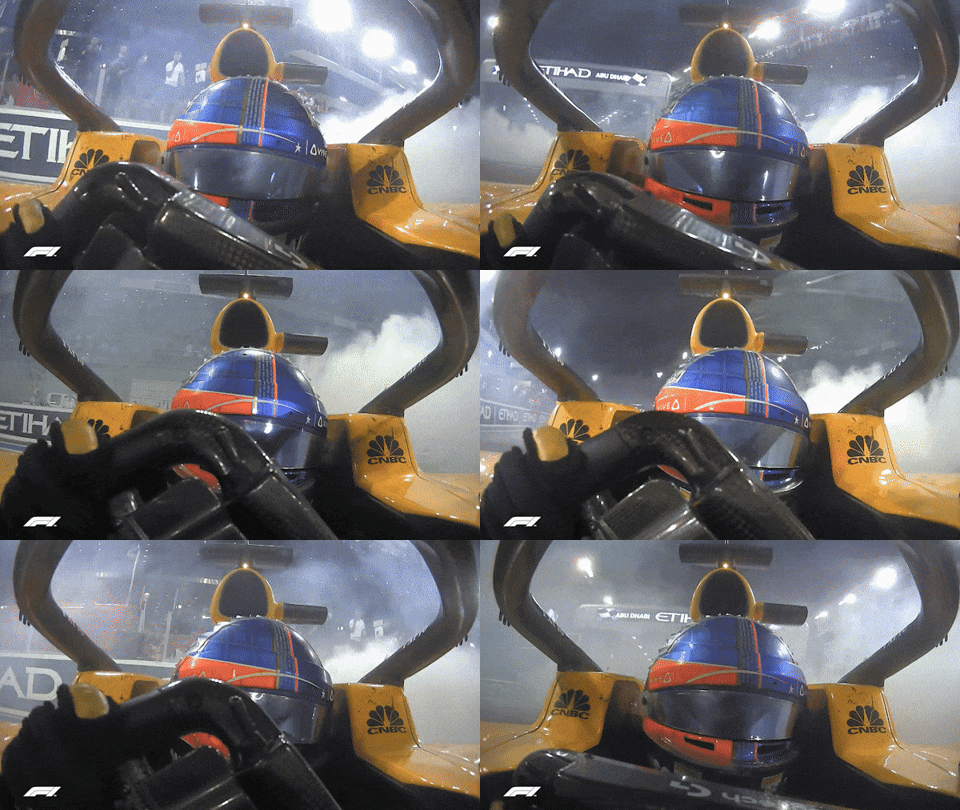
A top-class race car driver does not convert all the information coming from the car and the road surface into language. By the time a novice driver perceives a loss of traction, an expert might already have corrected it. Through many years of practice, an expert has developed an integrated perception of visual cues, sounds, vibrations, velocity, the position of the steering wheel, and the way the tires interact with the road surface.
But not every quick insight is a product of expertise. Psychologists Daniel Kahneman and Gary Klein have argued that there are shared requirements for turning expertise into reliable intuition. The world has to be regular enough that patterns can be learned. And there has to be adequate feedback available to validate (or invalidate) the conclusions reached. Without this, experience does not guarantee competence.
However, some professions and activities can provide feedback fast. For example, surgeons, drivers, athletes, and chess players can get almost immediate feedback and learn from it, but in other fields, feedback is less straightforward. Outcomes might not appear until several years later. Multiple factors combine to produce the results. Success might be attributed to talent, while failure is blamed on bad luck. In these situations, experience could easily lead to decades of untested beliefs.
The trust we place in experience comes from the assumption that experienced professionals have encountered more cases. Young prodigies may process information faster and have access to the latest knowledge. But the older expert might have seen the theory fail in six different ways (assuming they actually noticed those failures and connected the dots!).
It also appears that expertise doesn’t just make people quicker at performing certain tasks; it organizes them differently.
In an fMRI study, researchers compared how mathematicians and nonmathematicians viewed the same types of algebraic structures. The mathematicians’ brains were more selectively activated, while the nonmathematicians’ brains recruited more widespread frontal, parietal, and striatal areas. The researchers thought this meant that the mathematicians’ brains were more efficient and able to work on problems with a narrower area of neural activity whereas the less skilled brains had to rely more on top-down processing, working memory and focused attention.
Of course this doesn’t mean that experts always have to exert less effort or have less brain activation to solve a problem. Difficult problems might require more mental effort, even from highly trained people but their brains are simply better organized for their area of expertise. While a beginner needs multiple areas of the brain to process and recall the rules, intermediate results, and potential pitfalls, an expert simply understands the problem space. The lower effort doesn’t imply there’s less mental processing. Rather, fewer redundant processes are fighting for control, so the process becomes more efficient and less demanding.
Conscious control damages performance
When a skill has become highly automatic, increasing conscious attention to how it is executed can lead to lower performance. This is one explanation of why experts choke under pressure. When they’re feeling pressure, they’re more self-conscious. They try harder to ensure things go right and start monitoring parts of the skill that would normally run on autopilot. The golfer begins focusing on the angle of her wrist. The pianist starts wondering which finger is going to be used next. The effort to exert control over their skill interferes with the very mechanisms that normally support expert performance in the first place.
In a number of studies involving golfers, researchers found that experts were actually worse at remembering details of individual putts than novices. Their skills have become more procedural, and less reliant on consciously accessible steps. When their attention was redirected toward the physical mechanics of the putt, their performance suffered.
Pressure can disrupt our performance via different pathways. At times, anxiety interferes by drawing attention away from the task. At other times, people pay excessive attention to their own performance and thereby interfere with execution. These are known as explicit monitoring or transient hyperfrontality (essentially the opposite of transient hypofrontality) and describe a state of excessive top-down control, with strong anxiety, rumination, and overanalysis of small details.
Interestingly, some researchers have suggested that one reason activities like rhythmic exercise, dancing, knitting, gardening, or simply walking for a long time can reduce anxiety is that they may temporarily reduce the dominance of the prefrontal cortex and allow sensory and motor networks to take over more of the work.
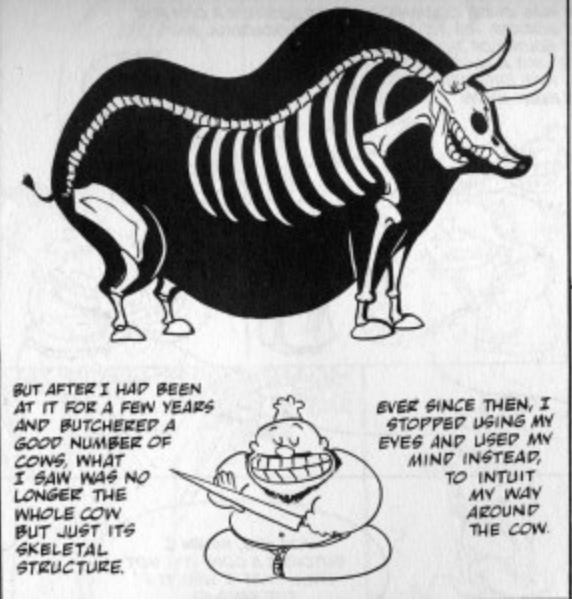
The Chinese philosopher Zhuangzi wrote more than 2000 years ago about artisans whose movements had become so attuned to their craft that they no longer seemed forced. The best-known example is Cook Ding, who carves up an ox with extraordinary ease. His knife moves only where there are gaps between the parts of the animal. He does not apply a prescribed sequence of motions to the object in front of him. Through years of repetition, his senses have changed so completely that he knows where his blade can travel.
In Japanese culture, thinkers came up with ideas like mushin, no-mind. It’s a mode of acting without being held back by the ordinary flow of self-conscious reasoning. The ideal actor combines mushin with riken no ken, or “seeing with another seeing.” An actor can act without continuously directing the act, while also being aware of the performance as a whole and its relation to the audience.
Aristotle’s idea of phronesis, or practical wisdom, involved understanding the broad principles and having enough experience to recognize when and how to apply them. While general rules can guide us toward virtuous action, they cannot possibly anticipate every situation or problem. The rules themselves were not sufficient to teach someone when and how to apply them.
In the 20th century, the philosopher Gilbert Ryle made a distinction between knowing-that and knowing-how. You may know that a particular finger goes on a piano key. You may know the physics of balancing a bicycle. You may be able to enumerate the steps involved in hitting a tennis serve. This does not mean that you know how to perform any of these actions. Ryle was trying to disprove what he called the intellectualist fallacy, which held that intelligent action could only result from prior rational thought about appropriate rules. If every intelligent action required a prior act of thought to determine how it should be performed, that prior act would itself require another act of thought, resulting in an infinite regress. Thus, intelligent behavior cannot always depend on first consulting another rule or principle.
Michael Polanyi developed a similar concept of tacit knowledge. There are activities that we recognize and perform but cannot describe in detail. We recognize the face of a friend without analyzing its features, and a scientist might sense a solution before calculating all the details. Polanyi believed that some forms of knowledge cannot be expressed as formal rules since they involve subjective assessment and experience. “We can know more than we can tell,” he wrote in The Tacit Dimension.
Hubert and Stuart Dreyfus offered a similar theory of learning. At the beginning, novices rely on very specific instructions. With experience, they come to see the world as specific cases rather than a collection of abstract facts so they don’t need to build every decision from scratch.
None of these writers and philosophers suggested that there is a single brain state responsible for this phenomenon. However, they all struggled with the same paradox: Although conscious monitoring is essential to achieving competence, overthinking the process interferes with achieving excellence.
Can flow be deliberately produced?
Likely not in the way most people expect. Trying to will yourself into flow requires you to monitor your mental state. You need to be able to step back and think, Am I in it yet? This kind of metacognition is the antithesis of flow. The instant that a person begins checking to see if they are experiencing flow, their attention is divided between the task and the act of checking whether they are in flow.
That said, there are steps that you can take to create an environment that is more conducive to the development of flow. Your task needs to be demanding enough to occupy your attention. The fundamental parts of the task need to be rehearsed to the point where they do not demand additional attention each time you do them. There needs to be a defined problem and some way to tell whether what you are doing is working. Interruptions are detrimental because they bring the outside world rushing back into awareness. All of these elements of your surroundings - time, messages, food, responsibilities, and even the fact that you are sitting at your desk - become salient again.
You must also be genuinely interested in solving the problem or in the activity you are doing. Enjoyment may not be particularly apparent during flow. You can feel discomfort, frustration or lack of progress for extended periods. At some point, though, something about the process must continue to draw you back. It might be curiosity, the thrill of competition, the pursuit of beauty, physical exertion, or the satisfaction of discovering something new. This explains why competence, deep knowledge, and familiarity help produce flow but are not enough on their own.
I have tried and mastered many athletic and intellectual endeavors throughout my life, and some of them leave me emotionally indifferent. I noticed that I never experience flow while doing them. There are others that cause the world to fade away, allowing me to lose myself in whatever I am doing.
The norepinephrine findings we discussed above raise another interesting question. If flow depends partly on reaching the right level of arousal, could we push the brain toward it chemically?
People are certainly trying.
In 2024, a paper was published suggesting that caffeine might facilitate flow. The authors drew connections between caffeine’s effects on alertness, dopamine, norepinephrine, reward, and executive function and various characteristics of the flow state. Note that this was not an experiment where researchers gave participants caffeine and observed them entering a flow state. It was merely a theoretical analysis.
The biohacking community has been conducting its own uncontrolled experiments for many years. Nootropics, productivity, and psychedelic microdosing forums are full of discussions of caffeine plus L-theanine, nicotine, modafinil, methylphenidate, amphetamine, cannabis, phenylpiracetam, and microdoses of LSD or psilocybin. Results of taking these are mixed, and some users report being absorbed in one task for hours; others mention feeling anxious, distracted, overly stimulated, or engaging in a weird form of perseverance in which they continue to work even when they aren’t making much progress.
Obviously, I am not recommending that anyone take any of the substances I’ve just mentioned. Lots of them are addictive, require a prescription, are illegal, or pose substantial psychiatric or cardiovascular risks. I included them here because people are already experimenting with different substances to artificially induce the state I am describing.

It is also important to note that pharmacologically enhanced focus and flow are not the same thing. For example, stimulants can improve wakefulness and persistence; nicotine can temporarily improve some aspects of attention; cannabis can make perceptual information (data collected by our senses) seem more compelling; psychedelics can make familiar things seem novel. Each of those effects resembles one piece of flow, but none alone is sufficient to produce flow.
Flow also requires a person to remain sensitive to feedback and responsive to changing circumstances. Chemically reinforced hyperfocus can become rigid, meaning a person can stay locked on a single topic long after it’s ceased to be a productive use of their time.
In one placebo-controlled study, researchers used the Flow State Scale, a survey instrument designed to measure aspects of flow, like intense absorption, reduced self-consciousness, feelings of control, and altered sense of time. Some participants who took a psilocybin microdose reported that their environment felt slightly more surreal, their imagination was more active, and their thoughts wandered more. The effect was modest and were reported mainly by people who correctly guessed they’d received psilocybin. Most crucially, the microdose did not increase flow-state scores or enhance creativity, well-being, or cognition.
A combination of caffeine and L-theanine, which has been shown to improve attention during demanding cognitive tasks, hasn’t been shown to actually produce flow either.
So far, it seems chemicals can tweak some of the factors associated with flow - wakefulness, anxiety, motivation, inhibition, reward, endurance. We don’t yet have a drug that can assemble those components into flow on command.
Nonchemical approaches
A systematic review found 29 flow interventions in sport and exercise. The most common was mindfulness, followed by hypnosis and mental imagery. Some experiments found improvements in individual dimensions of flow, but none demonstrated conclusive evidence that flow itself had been successfully produced.
Online discussions about personal flow rituals are less philosophical, but strikingly consistent. Phone is put in another room. Notifications are turned off. Same headphones or instrumental music. Food and water are prepped. Instead of sitting down to work, the person defines one specific problem.
Those rituals probably don’t cause flow. They eliminate competition.
There’s no longer any question about what to work on, no wondering if a message came in, no remembering three other responsibilities, no ongoing debate over whether to push forward. The ritual signals that the time for multitasking is over, and that the mind should stay put.
It might be the most practical way to conceptualize attempts at inducing flow.
We can raise arousal when it’s low, dampen anxiety, minimize distractions, define the goal, and shut down self-monitoring. We can carve out enough uninterrupted time for absorption to kick in.
But even after all that, flow might not happen.
All in all, I don’t think you can generate such a multifaceted state just by following a set of rituals or popping a pill. Nor do I think you need to be completely enamored with the topic/activity, but the task must offer some incentive for the brain to continue, and some competence is probably necessary.
Many people say that mastery, a high level of knowledge and practice in a domain, is what actually brings you close to the state of flow. But I don’t think mastery means reaching some perfect level of knowledge. It may mean knowing a subject or doing something at a level that doesn’t require much conscious control. Conscious control remains available for strategy and novelty, but it no longer interrupts every step of your thinking process. Sometimes the most intelligent thing your mind can do is step aside and allow the trained system to work and look for complex patterns and solutions.
And perhaps that is the most magical part of being human: there is still so much about our own minds left to discover.
Great article, Variana. I’ve been interested in/studying flow states for many years. I like what you said — “Flow also requires a person to remain sensitive to feedback and responsive to changing circumstances.” As a PhD folklorist and trained oral storyteller, with a career in organizational and leadership storytelling, I can tell you that the easiest way for anyone to experience mini flow states is through storytelling. Because storytelling requires a person to remain sensitive to feedback and responsive to changing circumstances.
For example, we all tell stories in daily life. When we fully share an experience we’ve had with others, and it’s a story that we’ve told before, several things naturally happen — we tell the story slightly differently because we are paying attention to who’s listening and gauging their reaction. You’ll often tell a story one way to a group of people, and a bit differently to another group of people. Because you are paying attention to the audience, the environment, and a whole host of other clues. As a result, the story will shift.
Now these flow states are short in duration unless you are telling stories from the stage. But the same principle applies because performance storytellers remove the 4th wall from the stage, shifting the telling to fit the audience, time, place, and 100s of other cues they are picking up in real time. Caveat: not every performance storyteller does this, but most do.
I’ve personally regularly experience flow states from storytelling. I’ve also asked 100s of clients about their experiences telling their stories, and that feedback consistently maps to flow state experiences. But I’ve yet to convince a researcher to test this hypothesis. LOL — I am usually about 5 years ahead in my anecdotal studies to when researchers conduct scientific studies. For years with clients I tracked what was happening between the storyteller and listener. It felt like all different areas of the brain were activated simultaneously between the two people. FINALLY, Yuri Hassen at the Princeton Neurological Institute took simultaneous MRIs of both a teller and a listener. The results validated my tracking and more.
But I’m convinced that storytelling is one of the most accessible ways anyone can regularly experience flow states. Thanks for letting me chime in :)
I got into flow many times during the Covid shutdown, when I had to work from home. I've concluded that, besides interest and appropriate level of challenge, safety was hugely important. Knowing that I would not be interrupted, as so often happened in the office, let me immerse myself in the problem at hand. In the office my time was/ is never safe. And during work hours I didn't have family or friend related demands or interruptions either. Just me and my work...