


Sociality is often described in psychological terms: temperament, personality, attachment - but its foundation is biological.
Every act of attention, conversation, or empathy burns fuel. The brain’s ability to sustain engagement depends on how efficiently its mitochondria convert oxygen and nutrients into usable energy (ATP). Connection is not free; it has a metabolic price.
When energy production is abundant and flexible, people seek novelty, motion, and stimulation. When energy becomes scarce or unstable, the nervous system conserves: minimizing input, controlling environment, narrowing focus. This is the hidden metabolic logic behind the spectrum from extraversion to introversion.
A Clue From Autism Research
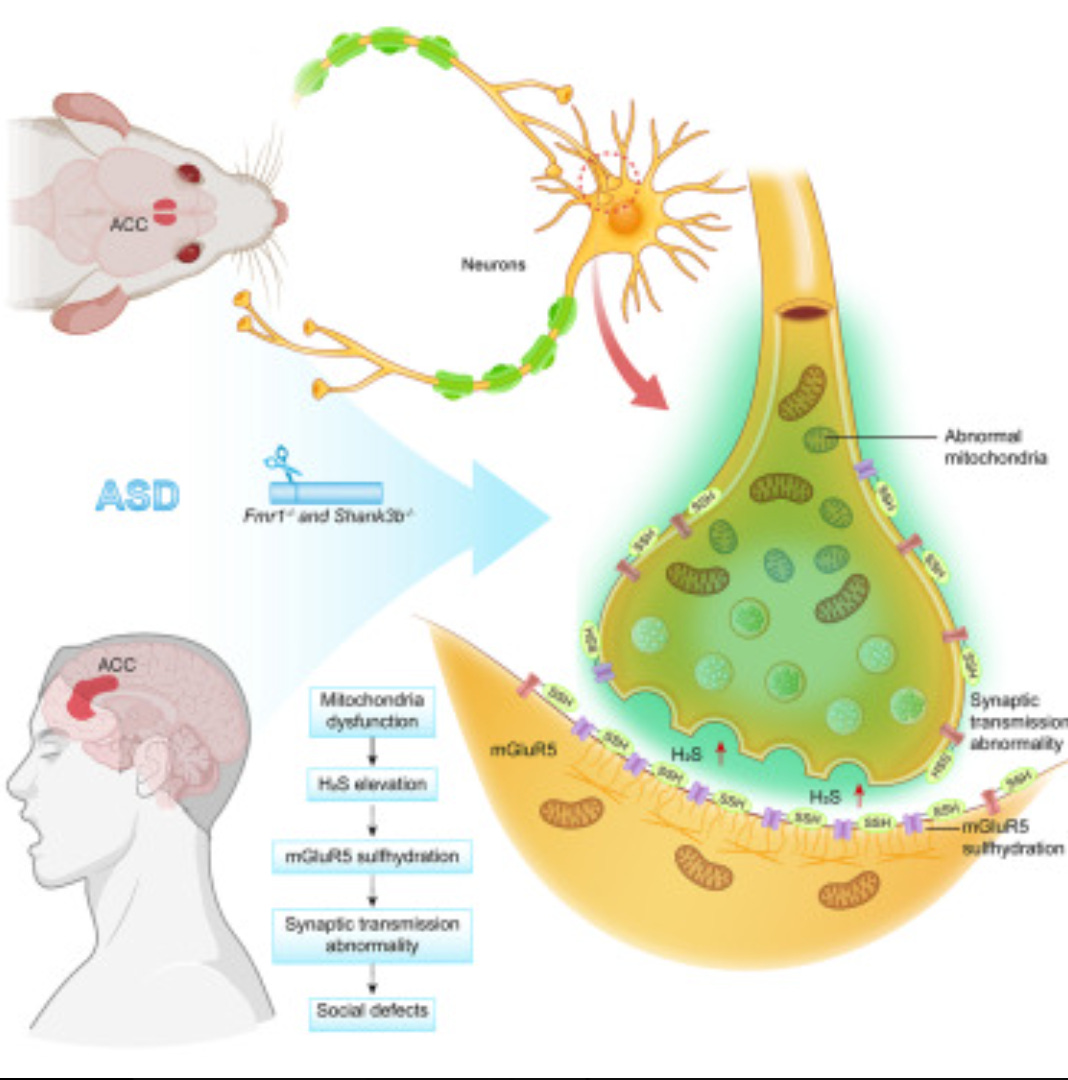
A recent Cell Metabolism study on autism made that logic visible at the molecular scale.
Researchers discovered that when neuronal mitochondria weaken, they release excess hydrogen sulfide (H₂S) - a signaling gas that, in high concentration, chemically alters synaptic proteins through sulfhydration. One target, mGluR5, a glutamate receptor critical for neuronal communication, becomes over-sulfhydrated and less responsive. Synapses misfire, social behaviors fade.
By restoring metabolic balance - either lowering the enzyme CBS, which produces H₂S, or modestly reducing sulfur amino acid intake - the researchers reversed social withdrawal in mice.
The implication was clear: social connection depends on cellular energy integrity.
When the cell’s “power plants” flicker, communication falters - chemically, then behaviorally.
The Energy Gradient of Personality
That same principle likely extends far beyond pathology.
Imagine social behavior as a spectrum governed by metabolic bandwidth:
High-throughput systems - efficient mitochondrial function, strong redox balance - can process more sensory and emotional input before depletion. They experience stimulation as rewarding, not draining.
Lower-throughput systems - limited ATP output or slower oxidative recovery - reach saturation faster. They seek quiet, predictability, and fewer variables to keep energy steady.
This gradient expresses itself in ordinary temperament: extraverts as energetic spenders, introverts as energetic conservers.
Mitochondria, Dopamine, and Redox Thresholds
Extraversion correlates with a more active dopaminergic system - the circuitry that rewards exploration and novelty. But dopamine signaling itself depends on mitochondrial health and the redox ratio (NAD⁺/NADH). A brain that regenerates NAD⁺ quickly can cycle through dopamine release and clearance efficiently, experiencing stimulation as energizing.
If that redox balance is impaired, dopamine spikes become exhausting instead of rewarding.
The introvert’s preference for calm isn’t psychological fragility - it’s redox conservation. Their mitochondria guard a narrower safety margin between excitation and oxidative stress.
Thyroid hormones, cortisol rhythms, and micronutrient availability (especially magnesium, copper, and B-vitamins) further tune these thresholds. Subtle metabolic differences set how wide or narrow each person’s window for stimulation truly is.
Introversion as Energy Awareness
Viewed metabolically, introversion is not social disinterest but energy awareness.
When external input exceeds mitochondrial capacity, the nervous system tightens its boundaries: smaller groups, slower tempo, controlled environments.
That reduction preserves coherence - just as cells restrict ion flux when ATP drops.
The behavior is defensive, not defective.
Extraversion, conversely, represents metabolic confidence: the system trusts its ability to recover from stimulation and pursues novelty to keep energy flow high.
Both strategies are adaptive expressions of underlying energy economy.
Expanding Capacity: Supporting the Energy System
Because personality rides on metabolism, it can shift subtly with biological context.
Periods of under-fueling, chronic stress, disrupted circadian rhythm, or nutrient deficiency narrow the energy window, pushing anyone toward introverted withdrawal.
Stability - consistent sleep, adequate calories, balanced macronutrients, sunlight exposure -restores resilience and often spontaneous sociability.
Principles that sustain mitochondrial coherence:
Regular light–dark rhythm: early daylight raises mitochondrial efficiency via circadian genes.
Sufficient carbohydrates: glucose maintains ATP production and prevents the stress chemistry that depletes redox reserves.
Micronutrient sufficiency: magnesium, copper, zinc, selenium, and B-vitamins enable antioxidant and sulfur-cycle enzymes.
Temperature and rest: warmth and full sleep lower oxidative load, freeing energy for engagement.
Predictability in environment: minimizes unnecessary sympathetic activation - less wasted fuel on vigilance.
These are not prescriptions for changing personality; they are ways of giving the organism enough energy to express its full range.
From Autism to Temperament: One Continuum
The autism paper demonstrated the extreme: when mitochondrial failure and H₂S excess silence social signaling entirely.
Introversion and extraversion lie on the same metabolic axis but within normal physiological limits.
Both are adaptations to the energetic cost of connection.
Where autism reveals what happens when energy collapse overwhelms communication, personality reveals how different metabolisms regulate communication sustainably.
The Law of Communication
At every scale - cellular, interpersonal, societal - the same rule applies:
the coherence of energy flow determines the clarity of communication.
When energy production is stable, organisms open to exchange.
When it falters, they withdraw, conserving what remains.
Extraverts and introverts are not opposites but complementary expressions of this law - two strategies for keeping the energy grid intact.
The difference is not psychological temperament alone, but how deeply the body trusts its own power supply.
As someone who fluctuates between introversion and extroversion this makes a lot of sense. When I'm tired, not eating properly or very stressed, I have nothing to give anyone socially. When all those boxes are checked, I could be out with friends for hours and not feel drained at all.
Excellent article.