
The Inner Fire: Thyroid Repletion and the Secret to Vitality (Complete Guide)

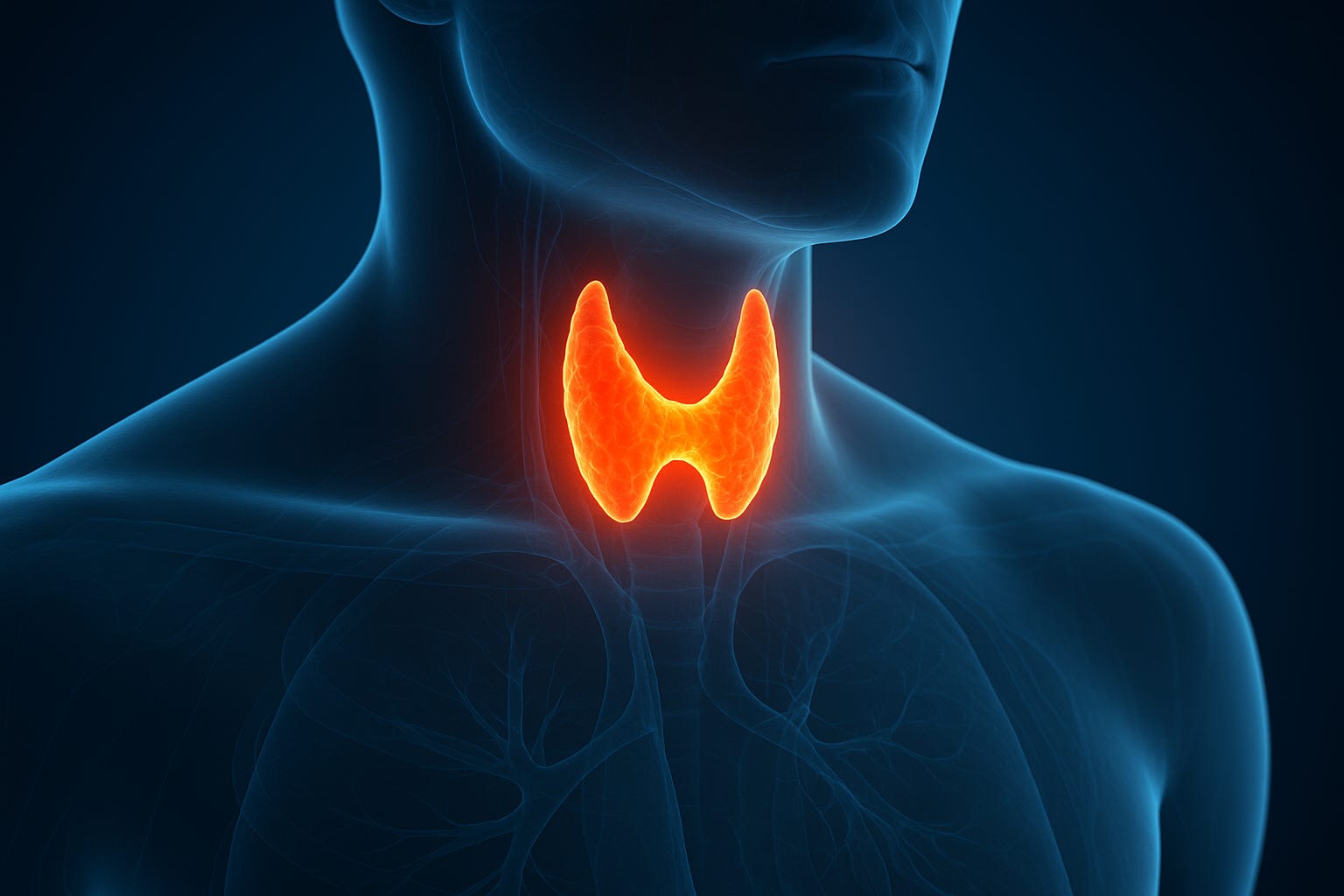
You restored fuel and minerals. You restarted digestion. Now comes the question that decides everything: is your thyroid actually turning that fuel into heat?
(If you haven’t yet read my pieces on bile and repletion, go back — those are the foundations.)
Because if the thyroid isn’t firing, everything else drags. Sex hormones flatline, mood collapses, and your body keeps you cold to conserve what little energy you’ve got.
What Low Thyroid Really Feels Like
This isn’t just theory. I lived it.
I used to think a low pulse was a sign of “fitness.” Doctors praised me for resting in the low 50s. But what it really meant was that I was living in permanent low energy - dragging myself through the day, cold hands, flat mood, no drive. It felt like hibernation, not life.
For women, low thyroid shows up as:
Short or anovulatory cycles, heavy or scant bleeding
PMS magnified until you barely recognize yourself
Cold hands and feet, dry skin, thinning hair, constipation
Low mood, anxiety, 3 AM wakeups, low libido
For men, it’s just as brutal:
Low morning erections, falling testosterone, low drive
Muscle melts away no matter how hard you train
Brain fog, apathy, cold intolerance, constipation
And for both sexes:
Waking temps below 97.8°F (36.5°C)
Resting pulses under 70 = low energy
Weight gain despite restriction
Bloating, slow transit, reflux from low stomach acid
Cravings with “no willpower”
And always, the insult of being told by doctors that this is “normal aging,” while your labs sit at the very bottom of the “normal” range. (I wrote about what’s actually optimal here).
Measure the furnace: temperature and pulse
The thyroid is your furnace. To know if it’s burning, you have to measure the flame.
It’s not complicated - just a thermometer, a pulse oximeter or your own wrist, and a notebook.
How to measure
Waking (before getting out of bed).
Oral temperature under the tongue for a full minute.
Pulse for 60 seconds at the wrist or neck.
Mid-day, 30–60 minutes after lunch. Repeat temp and pulse.
Evening, 60–90 minutes after dinner. Optional, useful during adjustments.
Targets (adults)
· Waking temp: 97.9–98.2°F (36.6–36.8°C)
· Mid-day: 98.6–99°F (37.0–37.2°C)
· Pulse: 70–85 bpm, steady
Patterns tell you the story:
Low temp + low pulse: classic hypothyroid. Not enough thyroid effect.
Low temp + high pulse: running on adrenaline. Eat more frequent carbs, salt, and address sleep.
Normal temp + low pulse: often low calories or high fitness with reduced output; confirm with symptoms.
High temp + racing pulse at night: stress, infections, or too much stimulant; stabilize meals and minerals.
Track for 7–10 days. Patterns are more honest than a single reading.
Daily Levers: How to Light the Furnace
Once you see the flame is low, here’s how you feed it. And let me say this: I used to think it was about cutting more - fewer meals, fewer calories, fewer carbs. That lie nearly ruined me. What actually lit the furnace was fuel, light, and rhythm.
1) Food timing and composition
Skipping breakfast used to feel like discipline. In reality, it was just cortisol in disguise. The game-changer was eating within an hour of waking.
Breakfast within 60 minutes of waking. Protein + fruit/roots. Example: eggs with cheese and fruit, or Greek yogurt with honey, or steak and orange juice.
3–4 meals per day, roughly every 4–5 hours. Avoid long gaps that spike cortisol.
Carbohydrates with protein at each meal to refill liver glycogen and support T3 conversion: ripe fruit, orange juice, potatoes, white rice, well-cooked roots, honey, dairy sugars.
Saturated fats: butter, ghee, coconut oil. Avoid heavy PUFA loads that blunt thyroid signaling.
Evening stabilizer if you wake at 3 AM: warm milk with honey and a pinch of salt, or gelatin + fruit.
2) Light and circadian rhythm
The thyroid listens to light. If you eat in the dark, live under blue light, or skip morning sun, you’re asking it to stay asleep.
Morning light to the eyes within 30 minutes of waking, 5–10 minutes outside when possible.
Anchor meals to daylight hours; make the largest meal earlier in the day.
Night hygiene: dim lights 2 hours before bed, cool dark room, no screens in bed. This lowers nightly cortisol and improves T4→T3 conversion.
3) T3 cofactors from food and supplements
These are the parts the thyroid relies on to produce and activate hormone.
Selenium (deiodinase and antioxidant support): 100–200 mcg/day from food (2–3 Brazil nuts occasionally) or a selenomethionine supplement.
Zinc (thyroid receptor function, steroid production): 10–25 mg/day with food. If using zinc regularly, include copper 1–2 mg/day from diet (liver, shellfish) or low-dose supplement.
Vitamin A (retinol) from 1–2 servings/week of liver or 2,500–5,000 IU/day retinyl palmitate if diet is low.
Magnesium 200–400 mg/day (glycinate or bicarbonate) for ATP and nervous system calm.
Riboflavin (B2) 10–25 mg/day supports thyroid and lipid oxidation.
B1 (thiamine): I can’t stress this enough. B1 - and its fat-soluble cousin benfotiamine - restores nerve function, energy, even lifts brain fog. It’s like flipping the switch on low-voltage wiring.
B12 if low or vegetarian history: 500–1,000 mcg methyl- or adenosylcobalamin a few times per week.
Tyrosine is usually covered by adequate protein; if intake is low, 250–500 mg can be trialed with breakfast.
Iodine: see section below before using.
Taurine: underrated. Supports bile, calms adrenaline storms, steadies blood sugar, helps T3 action at the cell.
4) Digestion first
This is the piece almost everyone skips and it’s why so many people fail on thyroid meds. You can swallow all the T4 or T3 in the world, but if your gut is inflamed and your bile is stagnant, that hormone won’t get converted, absorbed, or used.
Hashimoto’s and Graves’ are not just “thyroid diseases” — they are gut diseases too. Constipation, SIBO, gluten sensitivity, fortified iron, and PUFA oils all worsen the fire. Gut dysfunction impairs absorption of iron, zinc, selenium, copper, and B vitamins. Endotoxin (LPS) from gut bacteria suppresses T4 → T3 conversion, raises reverse T3 (rT3), decreases thyroid receptor sensitivity in the liver, worsens iodine reactivity, raising risk of Hashimoto’s when selenium is low. You cannot convert thyroid hormone with a hostile gut and stagnant bile. So fix your gut first. Move your bile. (See my bile protocol).
Labs
Once the gut is calmer, labs become meaningful. Otherwise they just reflect chaos.
Don’t aim for “normal.” Aim for optimal:
TSH: near 0.5–2.0 mIU/L correlates with better energy in many people.
Free T4: mid-range.
Free T3: high-normal. It is the active hormone that raises heat.
Reverse T3: low-normal. Elevated rT3 with low symptoms is a “brake.”
Thyroid antibodies (TPO, Tg): screen at least once. If positive, see iodine guidance and focus on gut/liver/selenium.
Ferritin, iron panel, B12, folate, vitamin D, magnesium (RBC), lipids: poor reserves make thyroid therapy feel like “jitters without energy.”
Use your tracker to monitor these over time.
(and see my article on optimal labs for more information).
Iodine: powerful, but context first
Iodine is essential for hormone synthesis, but reckless use has destroyed more thyroids than it has healed.
Do first: fuel, minerals, selenium. If antibodies are positive or you have a strong family history of autoimmunity, be conservative.
Doses: aim for nutritional iodine (150–300 mcg/day) from dairy, eggs, seafood, and small kelp tablets.
Avoid megadoses unless medically supervised with adequate selenium and clear indications. Excess iodine without selenium can raise antibodies and worsen symptoms.
Signs you may need more iodine: very low intake, low body temp with dry skin and hair loss, cystic breasts, and low urinary iodine tests. Again, start low and steady.
When supplements are not enough: medications overview
Here’s the truth: sometimes food and cofactors are not enough. And that’s okay. Thyroid hormone replacement isn’t failure - it’s leverage. But it only works on a nourished, low-stress baseline.
Common options:
Levothyroxine (T4 only). Long half-life, once daily. Useful if you convert well to T3, but many feel flat on T4 alone.
Liothyronine (T3). Shorter half-life, rapid effect on temperature and pulse. Often used in tiny doses 1–3 times/day or added to T4.
Combination therapy (T4+T3). Low-dose T3 layered onto T4 is a practical middle path.
Desiccated thyroid (NDT). Natural mix of T4, T3, T2, T1 and cofactors. Some feel best on it; others prefer standardized T4/T3. Quality and dosing consistency vary by brand.
Cynomel (T3): the “sharp blade” of thyroid. Potent, life-changing when used correctly - but dangerous if misused. Works best when split into micro-doses, always with carbs, salt, and protein on board.
Aspirin: technically not a thyroid drug, but synergistic. Lowers inflammation, blocks prostaglandins, steadies thyroid action at the receptor. With food, small doses often improve tolerance to T3. Watch for bruising, stomach irritation, or ringing in ears if dose is too high or if taken without food. Always pair with K2. With K2 in place, aspirin shifts from being a risky “drug” into a metabolic tool.
General principles
Start low, move slow. Tiny titrations while monitoring temp, pulse, sleep, mood, and bowel function.
Eat before dosing T3. Carbs and salt on board.
Watch metrics: rising waking temp and a steady pulse in the 70s–80s with calmer mood is a good sign. Palpitations and anxiety often mean “too much too soon” or “not enough fuel.”
Contra-notes: known cardiac disease, uncontrolled hypertension, severe anxiety, or starvation diets. Fix the foundation first.
Practical 7-day primer
Here’s how to live this for a week. Don’t overthink it — the point is rhythm, not perfection.
Every morning
Measure temp and pulse in bed. It sets your baseline. You’ll quickly see if your thyroid is warming you up or leaving you cold.
Eat breakfast within 60 minutes: protein + fruit/roots + salt. This shuts down the overnight cortisol surge and tells your liver it’s safe.
Get 5–10 minutes of outdoor light. This anchors your circadian rhythm and supports thyroid conversion.
Mid-morning
Adrenal cocktail: ½ cup orange juice + ½ cup coconut water + pinch of sea salt. This refuels potassium, sodium, and vitamin C — the minerals your adrenals burn through when you’re stressed.
Optional: take magnesium here if it calms your system.
Lunch
Biggest meal: ruminant meat or seafood + potatoes or rice + cooked fruit or juice. This is the thyroid’s “main fuel injection” of the day.
Optional: 100–200 mcg selenium with food if not covered by diet.
Afternoon
Walk or light strength work. Sunlight if possible. Movement helps blood sugar stability and digestion.
Dinner
Moderate protein + easy carbs. Think white fish and rice, or eggs and fruit.
If prone to 3 AM wakeups, add a stabilizer: warm milk with honey and a pinch of salt, or gelatin dessert with fruit. This keeps blood sugar steady overnight.
Evening
Dim the house. Screens off before bed. Breath work or reading. Your thyroid runs on rhythm, and rhythm runs on light.
Record how you felt, temp/pulse trends, sleep quality. Tracking builds awareness.
By the end of the week most people notice: warmer hands, fewer adrenaline surges, steadier energy, better bowel movements, improved mood, and deeper sleep.
Troubleshooting matrix
If things aren’t shifting, the problem usually isn’t the thyroid itself - it’s the inputs. Here’s how to decode the patterns:
Low temp and low pulse persist: you are still under-fueled or under-mineralized. Increase total calories, carbs with each meal, and salt. Check protein is ≥0.8–1.0 g/kg bodyweight.
Low temp, high pulse with anxiety: adrenaline state. Add a pre-bed carb + salt snack, eat earlier in the day, reduce stimulants, and ensure magnesium is in place.
Bloating or reflux increased: support stomach acid (betaine HCl with protein meals), keep portions moderate, and walk 10 minutes after meals.
Can’t tolerate even tiny T3 doses: fix sleep, raise carbs and salt, and check ferritin, B12, and selenium.
Women with cycle chaos despite better temps: consider progesterone status, thyroid-estrogen interplay, and liver clearance; re-check bile support habits.
Men with low T and warm temps: look at total calories, protein sufficiency, and micronutrients (zinc, vitamin A), then assess prolactin and SHBG with your lab plan.
What “on-line” feels like
Waking warm, steady pulse, no panic on opening your eyes
Real hunger at predictable times, satisfied by food
Regular bowel movements without strain, less bloating
Women: ovulation stabilizes, PMS softens, libido returns
Men: morning erections return, strength and drive rise
Sleep that holds all night, mood with backbone, skin looking alive
This is not a miracle. It is biology working.
Summary checklist
Measure temps and pulse.
Eat breakfast within an hour.
Carbs + protein at every meal.
Morning sun, low light at night.
Cofactors: selenium, zinc, B1, B2, B12, magnesium, vitamin A; iodine in nutritional doses only after the basics.
Fix digestion; keep bile moving.
Consider thyroid meds only on a nourished base, start low, titrate with data.
******************************************************
What Comes Next
If bile (Article 2) opened the door and nutritional repletion (Article 4) stocked the pantry, thyroid is the thermostat that finally turns that fuel into heat. Once warmth, pulse, and energy are steady, the next question is: are you actually making the hormones that drive resilience, libido, and stability?
That’s where we go next: steroid hormones. Progesterone, testosterone, cortisol balance - the layer that decides whether your body thrives or burns out.
Article 6 will cover how to rebuild progesterone in women, testosterone in men, and calm the cortisol storm in both. We’ll talk pregnenolone, cholesterol, vitamin A, and the levers that restore cycles, libido, strength, and mood.
Stay tuned - because thyroid is the spark, but steroid hormones are what let that spark fuel a full life.
A great article, I have hashimoto and take thyroid meds , I have low BP and I will try some of these and see how I feel. Thank you