
The Most Scientific Guide for Women: Training and Eating for Hormonal Adequacy & Fertility
The Story About Pulsating Hormones


Most women assume their hormones are “fine” because a period still shows up (you can blame your average OBGYN for that myth). That’s a low bar. Monthly bleeding doesn’t mean your body’s thriving. It doesn’t guarantee a healthy ovulatory rhythm or adequate estrogen and progesterone - it just means the bare minimum is still running.
Research shows that even with normal-looking cycles, low energy availability can quietly fracture the brain–ovary signaling that keeps fertility and metabolism alive.
Behind the scenes, many women are living in quiet energy debt. They train hard, eat clean, stay disciplined - yet their bodies are running on emergency power. Ovulation weakens, progesterone crashes, and metabolism slows.
Fertility doesn’t “shut off” all at once - it fades, cycle by cycle, when your brain decides there isn’t enough fuel to support life.
This isn’t about “trying to get pregnant.” Fertility is simply the proof that your system is alive, well-fed, and hormonally complete. When you’re fertile, everything else works - your metabolism, your sleep, your mood, your resilience.
When you’re not, nothing works right for long.
The Core Mechanism
Your brain talks to your ovaries in pulses. The pituitary releases luteinizing hormone (LH) in little bursts every few hours. Those pulses mature an egg, trigger ovulation, and support progesterone production afterward. When pulses are strong and rhythmic, you feel warm, energetic, mentally clear; when they slow, the signal weakens ovulation can fail, estrogen/progesterone fall, and cycles destabilize.
What scrambles those pulses? Not “exercise stress” per se. It’s low energy availability- what’s left after your training costs are subtracted from your intake. There’s a well-replicated threshold: ~30 kcal per kg of lean body mass (LBM) per day. Below that, LH pulse frequency falls (and amplitude may spike), estrogen/progesterone drop, cortisol rises, and the system shifts to survival architecture.
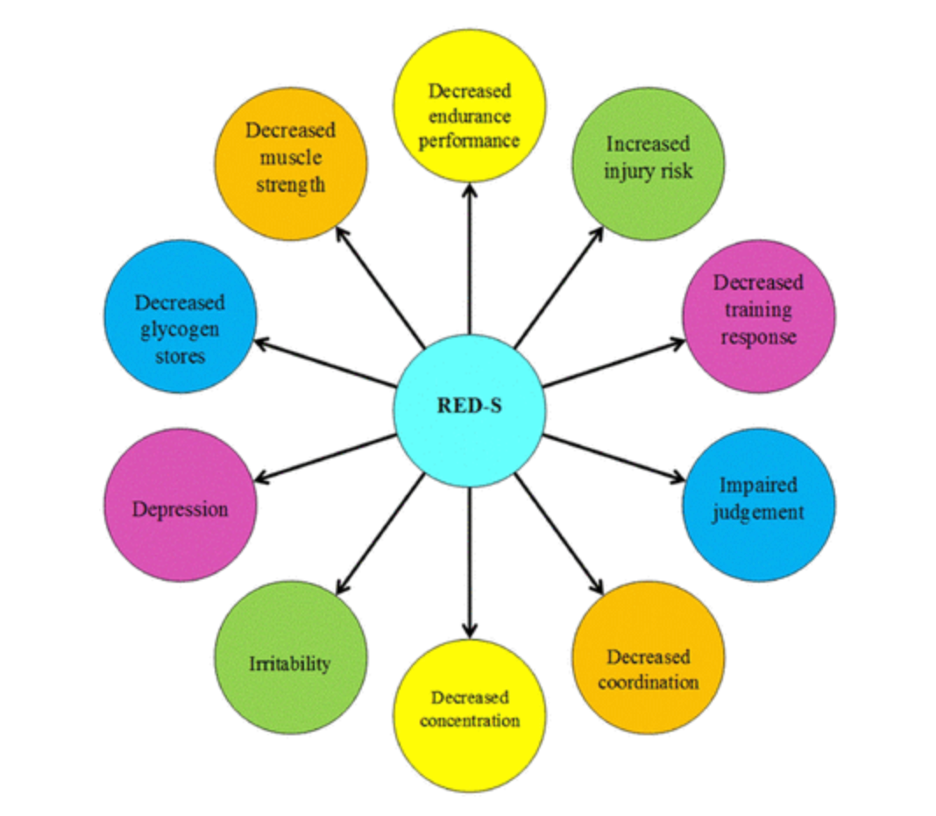
This is the physiological backbone of the Female Athlete Triad / RED-S framework: a mismatch between intake and expenditure impairs menstrual function, bone, immunity thyroid, and more.
Quick Definitions
Energy Availability (EA) = (Calories In − Exercise Calories) ÷ LBM (kg). Energy availability simply means how much fuel is left for your body after your workouts are done.
LBM (Lean Body Mass) = body weight × (1 − body fat %).
Think of your body like a household budget:
· You earn calories through food.
· You spend them through movement, training, and stress.
· Whatever’s left over is what your brain uses to pay for everything else - fertility, thyroid, mood, hair, skin, and warmth.
When the leftovers get too small, your body goes into conservation mode. It doesn’t care that you’re trying to stay fit - it reads it as famine.
EA zones
In women, the body starts to sense danger when energy availability drops below roughly 30 calories per kilogram of lean body mass (you can think of this as what’s left after workouts).
45+ kcal/kg LBM/day → Optimal for fertility, recovery, and robust metabolism.
30–45 → Maintenance (depends on stress, recovery, and training volume).
<30 → Risk zone: LH pulses slow; ovulation and sex steroids suffer.
<25 → High risk: suppressed ovulation, low estrogen, high cortisol.
Derived from controlled trials manipulating EA and tracking LH, thyroid, IGF-1, T3, leptin, and more.
Symptoms You’ll Recognize
Shortened or missing cycles, lighter bleeds, or “quiet” luteal phases
Cold hands/feet, lower waking temps, fatigue, low libido, brain fog
Sleep disruption (and/or feeling wired at night), training plateaus despite higher effort
These reflect the adaptive, protective state of low EA and growth-hormone resistance with low IGF-1.
You might still get your period, but under the surface, your hormonal rhythm is fractured - the same pattern seen in women who overtrain or undereat.
Calculate Your Personal EA (2 minutes)
Step 1 — LBM
Energy availability = how many calories you eat minus what you burn training, divided by that lean mass.
If you know body-fat (BF) %: LBM (Lean body mass) = weight × (1 − BF%).
Example: 60 kg at 25% BF → LBM = 60 × 0.75 = 45 kg.
No BF%? Approximate: Athletic/slim 75–85% lean; “average” 65–75% lean.
Step 2 — EA target
If you’re symptomatic or “off”: aim 40–45 for 8–12 weeks.
For basic safety: ≥30 (minimum floor).
Step 3 — Intake for your training
Formula: Intake = (EA × LBM) + Exercise Calories
Example (LBM 45 kg; you burn ~400 kcal in training/day):
Safety (EA 30): 30×45 + 400 = 1750 kcal/day (minimum)
Recovery (EA 45): 45×45 + 400 = 2425 kcal/day
In controlled trials, dipping below ~30 disrupted LH pulsatility even in women with regular menses.