


Another supplement post crossed my feed last week and it was wrong in so many ways that I had to write this short piece to clear up some of the confusion swirling around supplements right now. An influencer in the medical field wrote that “there’s no such thing as magnesium in nature, so you don’t have a deficiency of a synthetic chemical that was made up in a lab.” This is basic chemistry illiteracy, and I see versions of it constantly. The claims pile up: supplements are unnatural and synthetic and therefore inherently bad for you, they’re all made from mold, isolated nutrients don’t work, if you eat real food you don’t need anything, vitamin C is just synthetic garbage, and so on. The posts travel because they sound like brave truth-telling, and that’s a tone that performs well online right now.
I want to take this one apart, because I love chemistry and I can’t watch this kind of thing pile up unchallenged.
Start with the magnesium claim, because it made me laugh and furious in the same breath. Magnesium is element 12 on the periodic table. It’s the central atom in every chlorophyll molecule on Earth. Every green leaf, every blade of grass, every spinach leaf is built around a magnesium core. It’s the fourth most abundant cation in the human body. Without it, ATP can’t release energy, muscles can’t relax, and the heart can’t keep a steady rhythm.
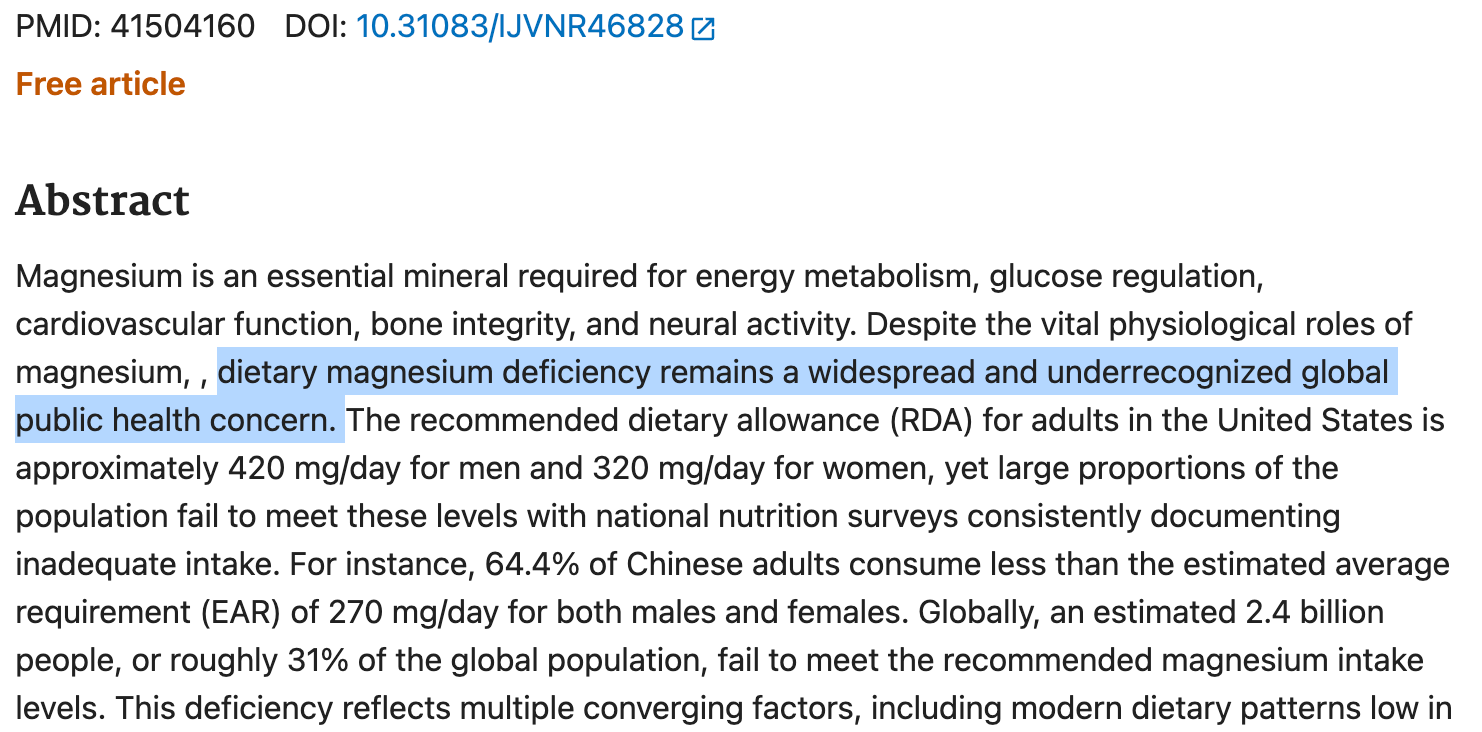
And here’s what makes this claim especially reckless. Magnesium deficiency is one of the most common nutrient deficiencies in modern populations. NHANES data showed that 48 percent of Americans consumed less than the required amount of magnesium from food in 2005-2006. Globally, about 2.4 billion people don’t meet recommended magnesium intake. Subclinical magnesium deficiency runs around 30 percent in any given developed-country population by serum measurement, and serum measurement underestimates actual deficiency because most magnesium is intracellular. In hospitalized patients the prevalence is higher. In ICU patients it can reach 60 percent. In postmenopausal women with osteoporosis, one study found magnesium deficiency in 84 percent. The drivers are well documented: soil depletion, processed food, refined grains, high phosphate intake, chronic stress, caffeine, alcohol, and certain medications all increase magnesium loss. Telling people who already run low on this mineral that it doesn’t exist as a real thing is the kind of misinformation that causes harm.
Underneath the magnesium claim and all the others I mentioned above is a chain of misunderstandings about what supplements are, where they come from, and how the body actually uses them.
And just to be clear, this isn’t a defense of the supplement industry. The industry has real problems, and I’ll get to them. This is about giving you the chemistry and the physiology to think for yourself, so you can tell the difference between a fair critique and an influencer chasing engagement.
The “unnatural and synthetic” claim
The most common attack is that vitamins and minerals in supplements are synthetic, lab-made chemicals, not the real nutrients found in food. Your body knows the difference. Real nutrients come with cofactors and a food matrix that the body recognizes. Isolated supplements are stripped of all that, so they don’t work, or worse, they cause harm.
There’s a grain of truth here and I’ll come back to it. But the broad claim that synthetic equals fake collapses on contact with basic chemistry.
A vitamin is a molecule, a specific arrangement of atoms bonded together. For example, vitamin C is ascorbic acid: six carbons, eight hydrogens, six oxygens, in one specific structure. Vitamin B1 is thiamine, with its own specific atomic blueprint. A mineral is an element, a single type of atom defined by the number of protons in its nucleus. Magnesium is 12 protons. Iron is 26. Zinc is 30. Iodine is 53. You can’t make an element “synthetic” or “natural.” A magnesium atom is a magnesium atom because it has 12 protons. It doesn’t matter whether it came from a spinach leaf, a mineral deposit, or seawater. Chemistry has no “natural” version and “synthetic” version of an element. There is only one magnesium.
For vitamins, the molecule is defined by its atomic structure. For most of them, the molecule extracted from food and the molecule made in a lab are structurally identical. Your cells use the same transporters to absorb them and the same enzymes to use them. There is no biological mechanism that detects a molecule’s origin story.
There are real exceptions to this, where natural and synthetic are not the same molecule. Vitamin E is one. Folic acid versus folate is another. I’ll come to those in a moment. But the broad claim that supplements are categorically fake or synthetic is just wrong.
The “isolated nutrients don’t work” claim
The next version of the attack: even if the molecule is the same, nutrients in food work because they come with cofactors and a food matrix. Isolated supplements don’t work, because the body needs the whole package.
This is half true, and the half that’s true matters. Nutrients do work in networks. Vitamin D needs magnesium and K2 to function properly. Calcium without magnesium can drive soft tissue calcification. Zinc taken alone for long periods will depress copper status. B vitamins work together. These ratios and cofactors are real, and people who megadose single nutrients without thinking about the rest of the network do create problems.
But “isolated nutrients don’t work” as a general statement is contradicted by every clinical case where supplementing a missing nutrient resolves a deficiency disease. Some of these interventions literally save lives. Thiamine alone reverses wet beriberi and Wernicke’s encephalopathy within hours. B12 injection alone reverses pernicious anemia, which was a death sentence before injections existed. Iodine alone reverses goiter in deficient populations. These aren’t whole-food interventions. They are isolated nutrients given to people who are deficient, and they work.
The honest version is this: isolated nutrients work to correct isolated deficiencies. They also work to support specific metabolic pathways when you understand which cofactors matter and dose accordingly. They don’t replace a real diet, because food provides hundreds of compounds that interact in ways supplements can’t fully replicate. The two aren’t in competition. Food is the foundation, and targeted supplementation fills in where the foundation has gaps.
The “just eat food” claim
This is the most popular version of the attack and the one that sounds the most reasonable. Eat real food, get sunlight, sleep well, and you don’t need any supplements.
I agree with the spirit of this. A foundation of liver, eggs, dairy, fruit, honey, gelatin, ripe fruit, meat, and seafood handles most of what your body needs. I write about whole-food nutrition constantly. But “just eat food” as a universal answer has problems.
Soil mineral content has declined. The 2004 Davis study, examining USDA nutrient data for 43 garden crops between 1950 and 1999, found measurable drops in protein, calcium, phosphorus, iron, riboflavin, and vitamin C. The reasons are debated, including monocropping, fertilizer practices, and faster-growing cultivars that accumulate fewer minerals. A carrot today is not nutritionally identical to a carrot in 1955.
Modern stress patterns burn through minerals at rates pre-industrial humans never experienced. Chronic adrenaline and cortisol drive urinary magnesium loss, potassium loss, B vitamin depletion, and zinc dumping. You can eat a clean diet and still run a deficit because your output exceeds your input.
Hypothyroid metabolism handles minerals poorly. Low cellular energy means weaker active transport. You can eat magnesium-rich food and still not absorb or retain it well if your thyroid is sluggish.
Some nutrients are genuinely hard to get in modern diets at therapeutic doses. Vitamin K2 MK-4 is found mainly in goose liver and grass-fed dairy fat. Most people eat neither. Adequate vitamin D from sun requires consistent midday exposure with skin uncovered, which most office workers don’t get for nine months of the year at northern latitudes. Iodine intake in the US has dropped significantly since the 1970s as people switched to salt, most of which contains no iodine. Only about half of retail table salt in the US is iodized, and food processors typically use non-iodized salt.
Where supplements actually come from
Some people claim B vitamins are “made from mold” or that you’re “eating mold” when you take them. There’s a real fact behind this, distorted into something it isn’t.
Many B vitamins, including B2 (riboflavin) and B12, are produced commercially through fermentation. A specific strain of bacteria or fungus is grown in a vat with sugar and nutrients. The microbe makes the vitamin as part of its normal metabolism. The vitamin is then separated from the microbe, purified, and tested. Riboflavin is produced using fungi like Ashbya gossypii or the bacterium Bacillus subtilis. B12 is produced using bacteria like Propionibacterium freudenreichii and Pseudomonas denitrificans.
This is the same process humans have used for thousands of years to make cheese, yogurt, bread, wine, beer, and miso. It’s similar to what your gut bacteria do every day to make some of the B vitamins and vitamin K2 you absorb from your colon. You’re not “eating mold” any more than you are when you eat sourdough bread or aged cheese.
Other supplements are made differently. Magnesium is mined from mineral deposits, then bound to an amino acid or organic acid (glycinate, malate, citrate, bicarbonate) to improve absorption. Vitamin D3 is typically produced by irradiating 7-dehydrocholesterol derived from lanolin in sheep’s wool, which is the same precursor and the same UV-driven reaction that happens in your skin. Vitamin A is extracted from fish liver oil or made by chemical synthesis. Vitamin C can be extracted from acerola or made by fermentation starting with glucose.
The fair question to ask about a supplement is not “is it natural,” because that word has no chemical meaning. The fair questions are: is it the correct molecule, is it pure, is it in a form the body can absorb, and is it dosed appropriately.
When source and form genuinely matter
There are specific cases where natural-versus-synthetic is not nonsense, because the molecules really are different, or where the form of the molecule changes how the body handles it.
Vitamin E. Vitamin E is one of those molecules that can exist in eight slightly different 3D shapes (called stereoisomers). Only one of these shapes occurs in nature, called d-alpha-tocopherol. The body has a specific protein in the liver that recognizes this natural shape and shuttles it into circulation. Synthetic vitamin E (labeled dl-alpha-tocopherol on the bottle) is a mixture of all eight shapes, only one of which matches the natural form. The other seven are less active or inactive, and the body clears them out faster. The net result is that natural vitamin E is roughly twice as bioavailable as the synthetic version. So for vitamin E, source genuinely matters. Always look for “d-alpha” on the label, not “dl-alpha.” Sunflower-derived is preferable to soybean-derived if you want to avoid soy associations.
Folic acid versus folate. Folic acid is a synthetic molecule that doesn’t occur in nature. Natural food folates are mostly reduced folate forms, often polyglutamated, which the intestine processes before absorption. Folic acid must be converted through dihydrofolate reductase (DHFR) before it can do anything, and human liver DHFR activity is limited. A 2014 human study found that shortly after ingestion, most folic acid reaching the liver was still unchanged. In other words, the gut was not converting it efficiently before sending it into circulation. When folic acid intake exceeds what the liver can convert, unmetabolized folic acid (UMFA) accumulates in the blood. Surveys have found UMFA in more than 95 percent of US adults exposed to fortified food. The biological effects are still being studied, but concerns include masking B12 deficiency, disrupting normal folate metabolism in the brain, and potentially feeding existing cancer cell proliferation. Natural folate from liver or the activated form 5-MTHF (methylfolate) in supplements, bypasses this problem.
B12 forms. Cyanocobalamin is the cheap, stable form used in most fortified foods and budget supplements. The body has to cleave off the cyanide group and replace it with a methyl or adenosyl group before it can use it. Methylcobalamin and hydroxocobalamin are the forms the body actually uses. For most people the difference is small. For people with certain genetic variants, or specific conditions like Leber’s hereditary optic neuropathy, cyanocobalamin can be harmful and the natural forms are clearly better.
B6 forms. Pyridoxine HCl is the cheap form used in most multivitamins. P5P (pyridoxal-5-phosphate) is the active form the body uses directly.
Vitamin C and acerola. This one is more nuanced than the marketing suggests. Ascorbic acid is ascorbic acid, chemically identical whether it came from a cherry or a fermentation vat. A randomized study with kiwifruit-derived versus synthetic vitamin C found comparable bioavailability. One small Japanese study with acerola juice did show modestly better retention and less urinary excretion compared to plain ascorbic acid, attributed to the bioflavonoids in acerola. The honest read: the molecule itself is the same, but acerola comes packaged with bioflavonoids (rutin, quercetin, hesperidin), polyphenols, and trace minerals that can modestly improve retention and add antioxidant synergy. So acerola isn’t “better recognized” by the body in some mystical way, but its cofactor package offers a small real advantage. The bigger consideration is dose. Acerola powder typically provides much smaller doses than isolated ascorbic acid, which can be a problem if you’re targeting therapeutic ranges.
Calcium forms. Calcium carbonate (chalk) requires significant stomach acid to dissolve and is poorly absorbed in people with low stomach acid, which is common in older adults and people on acid-blocking medications. Calcium citrate is absorbed regardless of stomach acid. Most cheap calcium supplements use carbonate, which means the dose on the label is not the dose that reaches your bloodstream.
These exceptions matter. For elements like magnesium, zinc, calcium, and iron, source is irrelevant at the atomic level (though delivery form affects absorption). For some vitamins, especially those with chiral structures or required activation steps, the molecule itself differs between synthetic and natural, and the body responds differently. Reading labels and understanding which form you’re actually buying is what separates effective supplementation from wasted money.
The industry does have real problems
Now for the legitimate critiques. They matter, because the better you understand them the better you can choose, dose, and protect yourself.
Forms matter. Most magnesium on shelves is magnesium oxide, which has poor bioavailability (around 4 percent in some studies) and mainly acts as a laxative. Most calcium is calcium carbonate. Most multivitamins contain folic acid rather than folate, and cyanocobalamin rather than methyl or hydroxo B12. Many vitamin E products are dl-alpha-tocopherol. Reading labels carefully is half the battle.
Quality varies. Independent testing has repeatedly found products that contain a fraction of the labeled dose, contain different compounds than what’s listed, or are contaminated with heavy metals. Brand selection matters.
Fish oil deserves its own warning. Polyunsaturated fats oxidize on contact with air, light, and heat. Most fish oil capsules are rancid by the time they reach the shelf. Rancid fats are pro-inflammatory and damaging. This is one supplement I think most people should reconsider entirely.
Marketing oversells. “Adrenal support,” “hormone balancing,” and “detox” formulas are mostly word salad. Proprietary blends hide actual doses. Stimulants and prescription drugs occasionally show up in products sold as natural.
People also megadose without understanding ratios. Taking 50 mg of zinc daily for months will tank your copper status. Hammering vitamin D without K2 and magnesium can drive soft tissue calcification. Taking high-dose B6 for years can cause peripheral neuropathy. Pulling one lever hard without thinking about the others creates new problems.
The answer is to be informed, use forms that actually get absorbed, dose for repletion and think about cofactors.
****************************************************
Vitamins and minerals are real molecules and atoms with real jobs, the body cannot synthesize the essential ones (that’s literally why they’re called essential), and modern conditions often leave gaps that food alone doesn’t close. Supplements are tools. They can correct a deficiency, waste your money, or create new problems depending on the form, dose, and context.
Start with food. Get a real diet in place before you supplement anything. Then add what your context demands, in forms your body can actually use, at doses that match your needs. Pay attention to which forms genuinely matter.
Be skeptical of aggressive claims, poor forms, and unhinged marketing. Be even more skeptical of people who tell you that essential minerals do not exist.
In an upcoming note, I’ll walk through the specific supplements I personally wouldn’t give up, with the mechanistic reasoning for each. Stay tuned.
This is a helpful correction to a lot of oversimplified narratives around supplements. The emphasis on chemical identity, bioavailability, and context really matters, especially when we think about long-term cardiometabolic health where deficiencies and imbalances can quietly influence risk over time.