
The Truth About the Heavy Salt Bath: What Osmosis Actually Does to Your Body

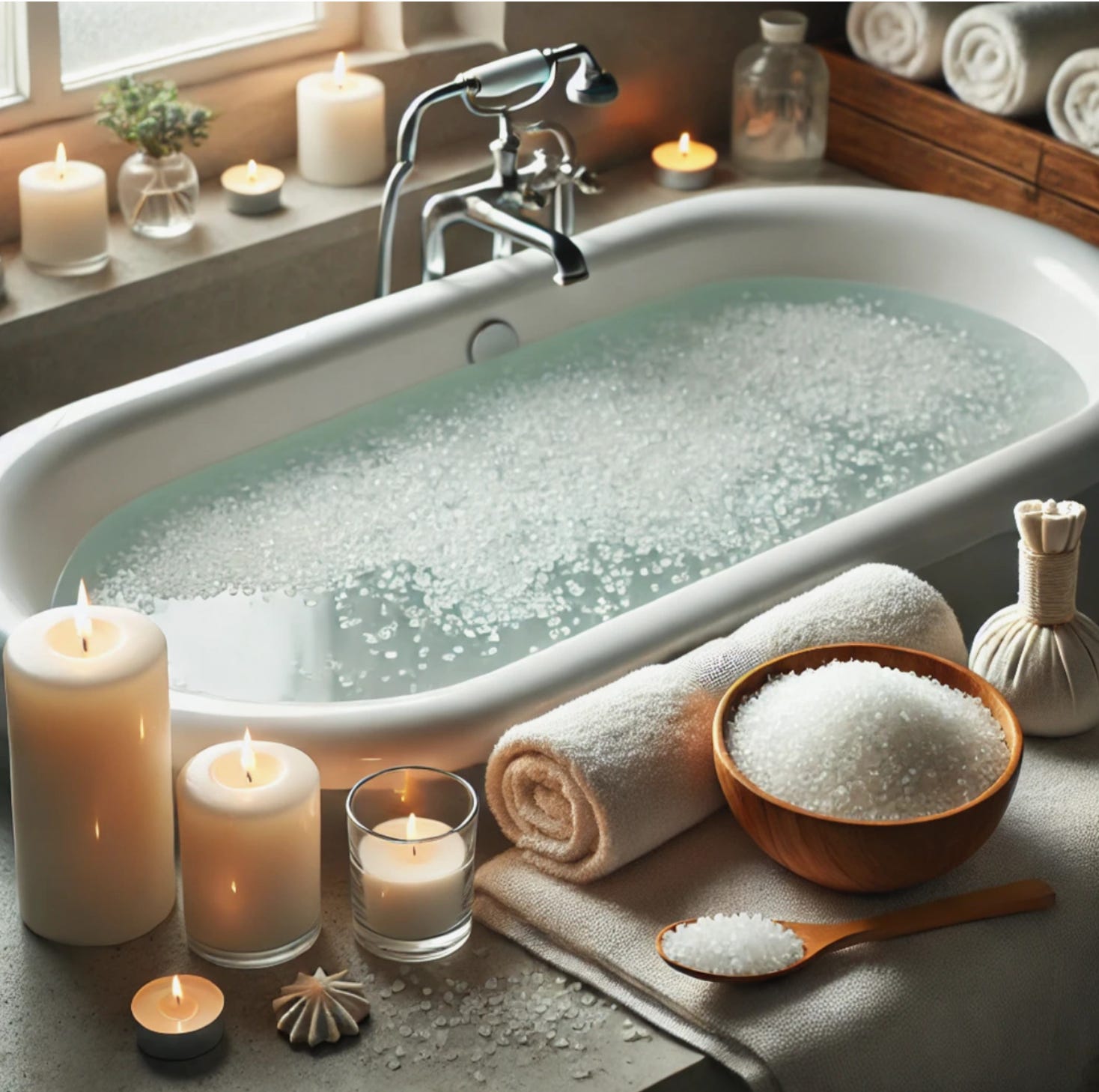
When I first wrote a post about alkaline baths on X, I had no idea it would trigger a wave of questions — everything from “Is it more potent if I use a full kilo of salt?” to “Why do I feel dizzy after my salt bath?” So let’s clear it up: alkaline and osmotic baths are not the same. One is therapeutic. The other is a controlled stressor.
People think they’re taking a simple salt bath. They pour in a kilogram of salt, maybe half a box of soda, sit there for an hour, start sweating, get dizzy, fall asleep like a tranquilized bear, and wake up feeling “light” and “emptied.” They assume it’s the same thing as a nervous-system alkaline bath. It isn’t even close.
An osmotic bath is a hypertonic, heat-driven fluid-shift event. You’re not “detoxing” in the poetic wellness sense. You’re pulling fluid out of your tissues, forcing aggressive sweating, pushing your circulation to the surface, dropping your effective blood volume, and then crashing into a parasympathetic rebound the moment you step out.
It feels dramatic because the physiology is dramatic. And unlike the alkaline bath, this one never had a medical institution behind it.
Today we’ll talk about why you might choose or avoid the osmotic bath, and the exact protocol to follow if you choose it.
What an Osmotic Bath Actually Is
When you dump huge amounts of salt into hot water, the water becomes hypertonic — meaning saltier than the fluid inside your tissues. The moment you sit in it, your body is dealing with a massive gradient. Water begins shifting outward. Circulation rises to the skin. Sweat glands turn on fast. Your heart rate climbs to stabilize blood flow. This is not a “soothing bath.”
If the alkaline bath is about calming, softening, balancing, and bringing your nervous system down, the osmotic bath is about forcing a physiological purge.
During an osmotic bath, tissues lose extracellular water - swelling, puffiness, and fluid retention drop. That’s the “my face looks sharper” effect. Heat alone dilates vessels, but salt traps heat and pushes even more circulation outward. You sweat harder than in a normal bath because sweat becomes the body’s main way to manage both heat and electrolyte shifts.
By the 40–60 minute mark, you’re not just warm. You’re actively losing fluid and electrolytes through two pathways at once: sweat and osmotic pull. When you finally get out, your autonomic system collapses from sympathetic drive into deep parasympathetic dominance, which is why people describe the sleep afterward as the deepest they’ve had in months. Nothing mystical. Just heat, osmosis, circulation, sweat, autonomic rebound.
The alkaline bath works by CO₂ physiology, smooth muscle relaxation, autonomic shift, bile flow, liver circulation, and inflammation reduction. It is predictable, gentle, and foundational. (Read the physiology of the alkaline bath here.)
The osmotic bath works by water loss, sweat, circulatory overload, electrolyte shift, and a forced parasympathetic rebound. It’s intense, draining, and meant to be occasional.
Why Eastern Europeans and Russians love Osmosis? Because it gives immediate, physical proof that something happened. They feel lighter - literally, because water weight drops; joints loosen as heat and circulation wash out the stiffness; head clears because blood redistributes properly; skin feels smoother and calmer; mood stabilizes because tension drains out with the sympathetic crash.
Some say it helps “detox” their bodies; others swear it makes their skin smooth and glowing. It’s especially helpful during long winters, chronic swelling, heavy physical labor, post-infection sluggishness, edema after travel, and periods of inflammatory heaviness. For them, it’s not a spa ritual — it’s a purge. Some use it to rebound from a cold or flu faster.
The alkaline bath has a formal scientific lineage - Soviet balneology, European spa medicine, early American hydrotherapy. The osmotic bath does not. It’s an evolution of bania culture, home remedies, amateur lymph drainage routines, and athlete weight-cutting tricks.
It’s a folk-physiology tradition that stuck because it produces unmistakable results. The ritual structure - warm up, get circulation going, sit for a full hour, sweat, then wrap up afterward - comes from the logic of sauna culture, not hydrotherapy textbooks.
What the Research Actually Supports
There is no formal literature on “one hour in 1 kg of salt.” But the individual components are documented.
Hypertonic solutions pull fluid out of tissue - that’s basic osmotic chemistry, and it’s used in wound care and edema reduction. Mineral-rich baths, especially Dead Sea–type water, have been shown to improve skin barrier function, reduce inflammation, and ease conditions like eczema and psoriasis. Sauna and hot bathing research is robust: improved circulation, reduced blood pressure, endothelial benefits, and a predictable autonomic shift.
So the mechanisms behind the osmotic bath are real. What doesn’t exist is a unified body of research treating this as an official therapy. It’s a folk method built on real physiology - not a formal medical system with protocols, scientists, and decades of controlled trials.
How the Home-Style Osmosis Protocol Works
People don’t jump into this bath cold. They warm up first - a few minutes of movement to open capillaries and get a bit of sweat going. Then they sit in hot, salty water with the level up to the heart line, not the neck. The bath lasts a full hour because the first twenty minutes are just warming; the strong effects only begin later, when sweating ramps up and fluid starts shifting.
Afterward, there’s always a rest phase. People rinse quickly, wrap themselves in something warm, lie down, drink salted water, and let the nervous system reset.
When It Makes Sense
There are moments where this bath delivers exactly what the body needs.
1. When you’re carrying visible fluid or puffiness/ When lymph feels slow or stuck
This is the classic case. Travel swelling, PMS water retention, puffiness from inflammation, a “heavy legs” feeling — the osmotic bath moves extracellular fluid more aggressively than anything short of sauna + exercise combined.
2. After viral illnesses or anything that leaves you inflamed and stagnant
Use it after flu, colds, inflammatory episodes, or long periods indoors in winter. The sweating + circulation surge gives a legitimate sense of clearing out the “post-virus sludge.” Some swear it can clear up a cough quickly or even stop a cold before it fully takes hold.
3. After long flights or sitting for hours
The bath pulls fluid down and out, and the heat drives blood back to the surface. Great for lower-body swelling and stiffness.
4. For rheumatism and spine or joint issues — the salt solution takes the load off your body so everything relaxes.
If your system is strong, your blood pressure is stable, and you feel generally resilient, the osmotic bath acts as a full-body purge and reboot.
When It Absolutely Doesn’t
Low blood pressure is the biggest red flag. You’re pulling fluid out of circulation and dilating vessels with heat. If your baseline pressure is already low, you will crash — dizziness, faintness, nausea are predictable.
Chronic exhaustion, heart conditions or adrenal fatigue do not mix with osmotic baths. This is a cardiovascular event. You sweat, lose electrolytes, and your heart works harder. Depleted people should not be stripping themselves further.
Pregnancy is a no. Alkaline bath is fine; this is not.
Difficulty regulating electrolytes? The bath becomes risky. You’re altering sodium, chloride, and potassium balance through sweat + osmotic pull. If the kidneys can’t compensate, it’s a problem.
People who confuse this with a “relaxation bath” learn very quickly why that was a mistake.
OSMOTIC PROTOCOL
Step 1 — Warm up first
This part matters. You don’t enter cold.
You move around for 5–10 minutes (walking, light stretching, house chores) to open circulation.
A cold, stiff body in a hypertonic bath is a recipe for dizziness.
Step 2 — Prepare a hot bath with high salt concentration
The standard robust formula is:
1 kg (2.2 lbs) of salt (some recommend 2–4 kg, which is a lot - build up slowly).
500 g of baking soda (optional! - added for skin comfort only)
Fill the bath hot enough to sweat, but not scalding
Water level to the heart line, not the neck
The heart line is traditional because it prevents overloading the cardiovascular system.
Higher concentrations are used for floatation setups, where a single tub can take up to 10 kg of salt - don’t do this at home. In my experience, 1 kg is enough to ease muscle pain, bring down swelling, and improve skin conditions like psoriasis, eczema, and atopic dermatitis.
Step 3 — Stay in for 45–60 minutes
The first 20 minutes don’t do much. The real osmotic effect begins between 30–45 minutes and peaks around 50–60.
Step 4 — Sweating is the goal
When someone is doing it correctly, they start sweating on the face and scalp even though they’re submerged.
This is how you judge whether the bath “took.” If you aren’t sweating, the bath was too weak, too cool, or too short.
By the end, circulation is wide open, sweating is intense, extracellular fluid has shifted, blood volume has dropped, and the body is ready to crash into deep parasympathetic dominance.
Step 5 — Rest immediately afterward
This part is non-negotiable.
Rinse fast, wrap in something warm, lie down, and rest for 20–40 minutes. This allows the nervous system to rebound and prevents a crash.
Step 6 — Hydrate with electrolytes afterward
Not plain water. Salt + water + something with carbs (fruit, juice, honey).
You have to replace what was lost.
You don’t do this daily
Once a week maximum for strong individuals.
Twice a month for most.
Remember: The alkaline bath is medicine. The osmotic bath is stimulus.
They are not interchangeable. They are not cousins and serve completely different purpose. Use the right one.
Do you use Epsom salt or sea salt? I have hEDS so constant joint and muscle pain and constant low blood pressure/high heartbeat. Epsom salt baths help w/ the pain! I personally think it’s worth some dizziness 😅 but I replenish with electrolytes each time.
A great follow up article building on the previous. The reason and evidence followed by the practical. This is what 'modern medicine' never does... Explains itself...