
The Strange Physiology of Belief
How attention, expectation, and interpretation become biological events

I’ve wanted to write about the relationship between mind and matter in health for a long time.
Alongside the more tangible, material side of health, I want to explore an idea that may be nearly as important: the body responds not only to what happens to it, but also to what it believes is happening.
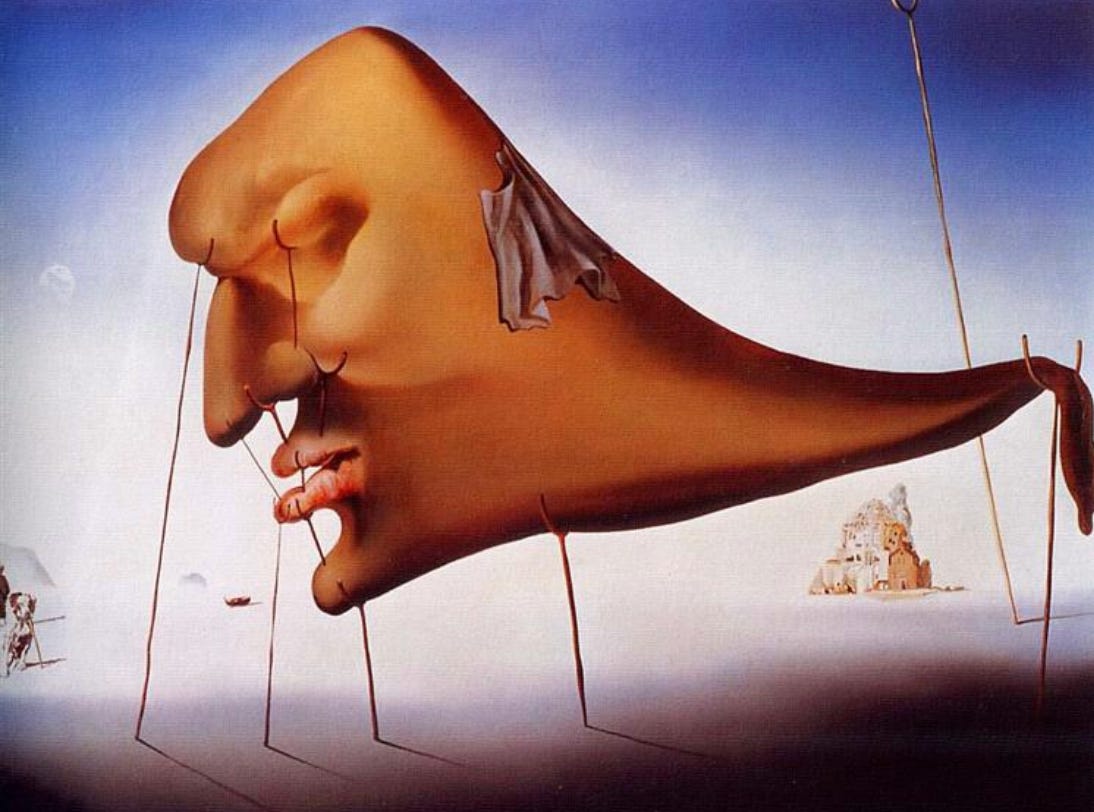
I was recently turning the pages of a book on Salvador Dalí when one of his most famous images stopped me. Dalí described sleep as a “huge, heavy head with a long, thin body balanced on the crutches of reality.” I could not escape the feeling that health rests on a similar arrangement. Each of us inhabits a world of our own, built from what we have learned to expect, fear, trust, and notice. The nervous system does not merely register inputs. It interprets them through the history it has already acquired.
The physical supports (crutches) are obvious enough: food, oxygen, hormones, minerals, sleep, movement, temperature, light. Yet the life of the organism is never determined by raw materials alone. Every physical event arrives already interpreted. A meal can be understood as nourishment, indulgence, contamination, or danger. A racing heart can signify terror, illness, anticipation, or readiness. Muscular strain can be experienced as evidence of damage or as the sensation through which strength is being acquired.
The body does not encounter the world as an objective inventory of molecules and forces. It encounters a world organized by significance.
Of course, belief cannot repeal biological reality. No amount of conviction can produce iron where there is none, compensate indefinitely for inadequate thyroid hormone, or make chronic sleep deprivation harmless. The more interesting proposition is that physiology responds both to what is present and to what the organism understands to be present. Meaning becomes one of the conditions under which matter is used.
Attention changes the body that is attending
Attention is usually treated as a light cast upon an already completed physical process. In practice, it participates in the organization of that process.
This is particularly visible in resistance training. A person can perform the same movement with the same external load while altering the internal distribution of effort through attention alone. In an eight-week study, participants performing arm curls were instructed either to concentrate on contracting the biceps or simply to move the weight. The internally focused group increased biceps thickness by 12.4 percent, compared with 6.9 percent in the externally focused group. It suggests that muscular adaptation can depend partly on how the nervous system represents the movement being performed.
The visible mechanics remained much the same, but the neural strategy differed. Attention can alter recruitment and coordination, as well as the quality of tension produced in a target muscle. The mind-muscle connection, often dismissed as bodybuilding folklore, appears to describe a real physiological phenomenon: conscious focus can influence where effort is organized.
Even imagined effort can modify physical capacity. In one experiment, participants repeatedly imagined maximal contractions of either the little finger or the elbow flexors without performing the movement. After twelve weeks, strength increased by 35 percent in the finger and 13.5 percent in the elbow. The investigators attributed the gains primarily to stronger neural drive rather than muscular growth.
Imagination did not substitute for training. It improved access to strength that the nervous system had not previously learned to summon as effectively. Part of what we call physical ability therefore resides not only in the tissue, but also in the brain’s capacity to recruit it.
A body may possess capacities that remain partially unavailable until attention, confidence, repetition, or necessity changes the nervous system’s willingness to use them.
The body digests the idea of a meal
Nutrition is often discussed as though food enters an indifferent machine. Protein is absorbed, glucose is oxidized, fat is stored, and the mind matters only when it interferes with dietary compliance.
Yet eating begins before food reaches the stomach. Smell, expectation, memory, presentation, social context, and appetite initiate physiological preparation. Salivation, gastric secretion, insulin release, motility, and digestive enzyme activity are all influenced by anticipation. The body does not wait passively to analyze food after it arrives. It forms a prediction about what is coming and begins responding in advance.
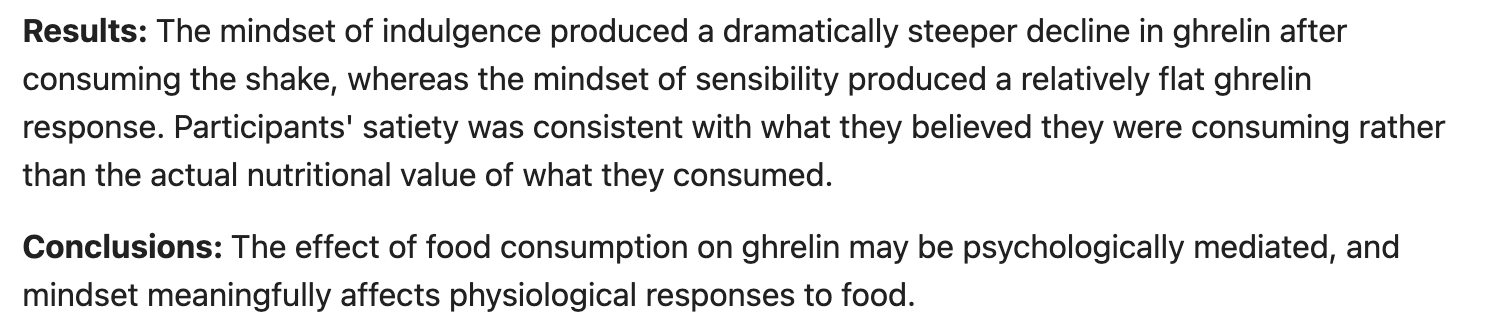
The “mind over milkshakes” experiment offered a particularly interesting demonstration. Participants consumed the same 380-calorie milkshake on two occasions. On one occasion it was presented as a decadent 620-calorie indulgence; on the other, as a restrained 140-calorie diet drink. Although the nutritional content was identical, ghrelin fell much more sharply when participants believed they had consumed the indulgent shake. “Participants’ satiety was consistent with what they believed they were consuming rather than the actual nutritional value of what they consumed.”
This does not make calories fictional, of course, and it does not suggest that a label can indefinitely override nutrient composition. It reveals that the physiological event called eating includes the meaning assigned to the food.
A meal eaten with pleasure and confidence may not produce the same physiological response as the identical meal eaten with suspicion or fear. In the latter situation, a person is simultaneously anticipating inflammation, weight gain, digestive failure, or loss of control. That anticipation can alter autonomic tone, muscular tension, appetite, gastric activity, and the interpretation of every sensation that follows.
This is why I believe food should be eaten with pleasure. Enjoyment is not an ornamental addition to nutrition. It helps place the meal inside a context of nourishment rather than threat. The same principle applies when one chooses to indulge. Eating something enjoyable and then spending the next several hours condemning oneself for it turns a brief pleasure into a prolonged stress response.
When Work Becomes Exercise
A study by Alia Crum and Ellen Langer carried this idea from the dining table into daily work. Eighty-four hotel room attendants were divided into two groups. One group was told that the physical labor they already performed met, and in some cases exceeded, prevailing exercise recommendations. The other group received no such information. Four weeks later, the informed group showed reductions in weight, blood pressure, body fat, and body mass index, despite reporting no corresponding increase in exercise outside work.
The findings raise an intriguing possibility: physical activity may affect us differently when it is recognized as purposeful exercise rather than dismissed as invisible labor. The rooms were cleaned in either case, but the activity acquired a new meaning, and the body appeared to respond accordingly.
Your metabolism does not run on food alone. It also runs through what you believe the food represents, what you believe your body is capable of, and whether the world around you appears hospitable or hostile.
Expectation has chemistry
The placebo effect is often described as evidence that symptoms were imaginary.
An experience can be generated or modified by the brain without being unreal. Pain is not a direct measure of tissue damage. It is shaped by sensory input, memory, expectation, context, attention, and perceived danger. Placebo pain relief is therefore not imaginary. Expecting relief can change how the nervous system interprets those signals and genuinely reduce the pain a person feels.
In one of the classic experiments, researchers studied patients experiencing pain after dental surgery. Some patients were given a placebo and nevertheless reported substantial pain relief. The researchers then gave them naloxone, a drug that blocks the same opioid receptors used by morphine and by the body’s own endorphins. Once those receptors were blocked, much of the placebo pain relief disappeared and the pain returned. This suggested that the expectation of relief had prompted the body to activate its own opioid pain-control system.
Parkinson’s disease provides another interesting example. Brain scans have shown that simply expecting treatment can cause the brain to release dopamine. In one study, this happened when patients were told they had a 75 percent chance of receiving the real medication. When they were told the chance was lower, the same dopamine response did not appear.
The point is that patients did not simply feel more hopeful. Their expectation triggered dopamine release in a part of the brain directly affected by Parkinson’s disease.
This helps explain the potency of medical ritual. The confidence of the practitioner, the formality of the setting, the reputation and cost of the treatment, and the language used to explain it all influence what the nervous system predicts will happen next. Pharmacology and surgery remain material interventions, but neither is ever delivered in a psychological vacuum. Every treatment arrives with an interpretation that may amplify, diminish, or distort its effects.
The immune system can be conditioned
The influence of expectation becomes more difficult to dismiss when it reaches immune function.
Classical conditioning is usually introduced through Pavlov’s dogs, which learned to salivate in response to a cue associated with food. Comparable associative learning can occur in systems far removed from conscious intention.
Researchers wanted to know whether the immune system could learn to respond to a harmless signal. They repeatedly gave participants an immunosuppressive drug, which reduces the activity of immune cells, together with a drink that had an unusual taste. After the body had learned to associate the two, the same drink was given again without the full drug dose. Even then, tests showed that immune activity was suppressed, as though the taste itself had begun to signal the effect of the medication. This principle has also been explored in kidney-transplant patients, who need immunosuppressive drugs to prevent their immune system from attacking the transplanted organ.
From the study: “These data demonstrate, proof-of-concept, that learned immunosuppressive placebo responses can be used as a supportive, placebo-based, dose-reduction strategy to improve treatment efficacy in an ongoing immunopharmacological regimen.”
This complicates the familiar division between mental memory and bodily memory. Experience is retained not only as a story we can tell, but also as altered motor habits, autonomic reflexes, threat thresholds, endocrine patterns, and expectations about what will happen next. The organism prepares for recurrence even when the conscious mind is not deliberately remembering.
I think that the significance of these experiments reaches beyond immunity. They show that the body can learn an association and continue responding to it without any conscious decision. A taste becomes linked to immune suppression; a movement may become linked to pain or pleasure; a posture, touch, or environment may become linked to danger. What the body has repeatedly experienced can shape what it prepares for next.
The therapeutic ritual may contain more of the treatment than we realize
One of the most unsettling placebo-controlled trials involved arthroscopic surgery for knee osteoarthritis. Participants received one of two real procedures, either rinsing the joint with fluid or removing damaged tissue, while a third group underwent a sham operation in which incisions were made but nothing was done inside the knee. Over the following two years, the real procedures produced no better results for pain or function than the sham surgery. All three groups improved.
This does not mean that surgery as a whole is ineffective. It means only that these particular procedures offered no measurable benefit beyond sham surgery. For the patients, the signs of surgery were convincing: they entered a hospital, received anesthesia, woke with incisions, went through recovery, and believed that the damaged knee had been examined, cleaned, and repaired.
That experience gave the nervous system a compelling reason to revise its expectations about pain, movement, and vulnerability.
Belief can become pathogenic
The same predictive machinery that permits relief can also intensify suffering.
In the SAMSON trial, participants who had abandoned statin treatment because of side effects alternated among statin tablets, placebo tablets, and periods with no tablets, recording their symptoms each day. Symptoms increased substantially during months in which tablets were taken, but their intensity was similar whether the tablets contained a statin or a placebo. Approximately 90 percent of the symptom burden associated with statin months was also present during placebo months.
Once a person expects a substance to cause pain, fatigue, nausea, or cognitive disturbance, ordinary fluctuations in bodily sensation acquire a new meaning. Attention narrows and monitoring intensifies. Sensations that might otherwise have passed unnoticed become salient, while anxiety and autonomic arousal can generate additional symptoms that appear to confirm the original expectation. A prediction can begin producing its own evidence.
This is the nocebo effect.
Language can increase pain. A frightening explanation delivered with medical authority can reorganize a person’s relationship to their body for years. Health information can clarify experience and restore agency, but it can also colonize attention. Once every headache, palpitation, digestive fluctuation, or moment of fatigue is interpreted as evidence of hidden damage, the body becomes an object of continual surveillance.
A body continuously watched for betrayal is unlikely to feel safe.
What we call “vibe” may be compressed biological judgment
The word “vibe” is imprecise, but perhaps its usefulness lies in that very compression. It names the total impression created before the analytical mind has separated its components.
The nervous system is continuously estimating whether a place, person, meal, movement, or possible future is safe enough to approach. Posture, facial expression, voice, temperature, light, smell, social hierarchy, memory, novelty, and innumerable other signals contribute to that judgment, often without becoming fully conscious.
A bad vibe may be the conscious residue of a vast amount of unconscious pattern recognition. Its physiological consequences can include changes in breathing, vascular tone, muscular guarding, appetite, motility, vigilance, and exploratory behavior. A favorable environment produces a different configuration. Attention broadens, movement becomes easier, appetite often returns, and energy becomes available for purposes beyond immediate protection.
This may help explain why energy cannot be understood only as fuel availability.
An organism can possess energy and remain reluctant to spend it. Expenditure depends partly on prediction. When the future appears dangerous or futile, conservation becomes rational. When the environment offers safety, pleasure, status, intimacy, or possibility, the organism has more reason to invest.
What people loosely describe as high energy may sometimes reflect this permission to spend. Exhaustion, conversely, is not always a simple absence of resources. It can also involve sustained vigilance, chronic inhibition, learned helplessness, or an organism that no longer expects a meaningful return on effort.
Identity provides the body with a long-term forecast
Beliefs about the self may be especially influential because they are not isolated thoughts. They are durable predictions that shape behavior, posture, attention, and interpretation over long periods.
A person who understands themselves as physically fragile will often move differently from someone who regards their body as adaptable. They may avoid strain, interpret soreness as injury, and attribute normal fatigue to decline. Over time, the belief alters activity, and altered activity reshapes the body in the image of the belief.
The same process may occur with aging. A person who expects age to bring inevitable deterioration can begin cooperating with that future long before it arrives.
In a longitudinal study of 660 adults over the age of 50, those with more positive perceptions of their own aging lived an average of 7.5 years longer than those with more negative perceptions, even after adjustment for several demographic and health variables. The study was observational, so it cannot prove that attitude itself caused the difference. Still, the magnitude of the association suggests that beliefs about aging may become biologically consequential through behavior, stress physiology, social engagement, motivation, and interpretation of symptoms.
We may gradually become the organism for which we have been rehearsing.
Perhaps this is one reason a loving partner can matter so much: someone who reminds us that we are loved, that we still look wonderful to them, and that they see us with the same admiration they felt when we first met, even as the years pass and we continue to change.
This does not mean that illness is a failure of imagination or that suffering can be overcome through forced optimism. None of this should be mistaken for another sermon about positive thinking. “Think better and become healthier” is as crude as claiming that thought has no effect at all. Causality runs in both directions.
A person with inadequate thyroid function, anemia, unstable blood sugar, chronic pain, or severe sleep loss may experience pessimism, anxiety, cognitive dullness, and loss of motivation because the physical state of the brain has changed. Hypothyroidism, for example, is strongly associated with fatigue, slowed cognition, depressed mood, and anxiety. Correcting the deficiency often improves those symptoms.
When someone trains, eats, or tries to change their body from a place of constant self-contempt, the effort itself becomes another source of stress. The body does not separate physical discipline from the emotional environment surrounding it. Pleasure, affection, admiration, and the feeling of being genuinely wanted are not trivial extras outside health; they help create the sense of safety in which a person can relax, recover, and grow.
The body lives under interpretation
The old division between mind and body has encouraged two equally inadequate philosophies. One imagines the body as machinery and consciousness as a largely irrelevant witness. The other treats matter as infinitely obedient to thought and turns health into a test of psychological purity.
Human beings inhabit neither world.
We are material organisms whose material processes are continuously modified by anticipation, memory, attention, relationship, and meaning. The body requires actual nutrients, actual rest, actual oxygen, and actual structural integrity. Yet it uses those realities within a regulatory system shaped by what it expects, fears, notices, and desires.
Perhaps this is what Dalí’s image captures. The head is vast, unstable, and strangely powerful, but it cannot float free. It remains dependent upon the crutches that connect it to the physical world. Health is formed within that tension, through the perpetual exchange between material support and lived interpretation.
References:
Schoenfeld BJ, Vigotsky AD, Contreras B, et al. Differential effects of attentional focus strategies during long-term resistance training. European Journal of Sport Science. 2018.
Ranganathan VK, Siemionow V, Liu JZ, Sahgal V, Yue GH. From mental power to muscle power: Gaining strength by using the mind. Neuropsychologia. 2004.
Crum AJ, Corbin WR, Brownell KD, Salovey P. Mind over milkshakes: Mindsets, not just nutrients, determine ghrelin response. Health Psychology. 2011.
Crum AJ, Langer EJ. Mind-set matters: Exercise and the placebo effect. Psychological Science. 2007.
Levine JD, Gordon NC, Fields HL. The mechanism of placebo analgesia. The Lancet. 1978.
Lidstone SC, Schulzer M, Dinelle K, et al. Effects of expectation on placebo-induced dopamine release in Parkinson disease. Archives of General Psychiatry. 2010.
Goebel MU, Trebst AE, Steiner J, et al. Behavioral conditioning of immunosuppression is possible in humans. The FASEB Journal. 2002.
Kirchhof J, Petrakova L, Brinkhoff A, et al. Learned immunosuppressive placebo responses in renal transplant patients. Proceedings of the National Academy of Sciences. 2018.
Moseley JB, O’Malley K, Petersen NJ, et al. A controlled trial of arthroscopic surgery for osteoarthritis of the knee. The New England Journal of Medicine. 2002.
Howard JP, Wood FA, Finegold JA, et al. Side effect patterns in a crossover trial of statin, placebo, and no treatment. Journal of the American College of Cardiology. 2021
Levy BR, Slade MD, Kunkel SR, Kasl SV. Longevity increased by positive self-perceptions of aging. Journal of Personality and Social Psychology. 2002.
I have goosebumps from this article and the realization of how much we program ourselves...
Check out the book Beyond Belief by Nir Eyal. It is a wonderful book.