


A colleague at a conference last year carried a 90-ounce water jug everywhere she went. One of those giant almost three liter jugs. She refiled it constantly and excused herself to the bathroom every twenty minutes. Between sessions she complained about stiff hips and aching shoulders. I asked her why she was drinking so much and it turned out that her doctor had told her to drink more.
What struck me was that she looked more dehydrated than ever: gray undereyes, dull skin, that drained look you can see before a person even starts telling you what is wrong. She was doing everything right according to the advice she had been given but that advice was built on a model of hydration that doesn’t match how the body actually holds water.
The water she drank and the water her tissue could hold were governed by two different systems. Flooding the first does almost nothing for the second. Worse, in her case the flooding was actively stripping the minerals she needed to hold water in her tissue, so the harder she tried, the drier she got. She was working against her own physiology.
*******************
In Part 1, I covered the basics: the history of fascia, Stecco’s Atlas, and why this tissue is not passive wrapping but a living sensory and mechanical system.

This piece is about why fascia dries out, what actually rehydrates it, and why “drink eight glasses” is one of the most misleading pieces of advice in modern health. If your fascia is dry, everything downstream of it suffers. Sliding surfaces stop sliding. Joints get stiff. Skin loses plumpness. The body feels heavier, older, less responsive. It is one of the mechanisms underneath what people call aging.
The molecule is a spring that can collapse
Fascia is roughly 60 to 70 percent water. That water is held in place by hyaluronic acid, a long sugar chain that behaves like a molecular spring. When fully extended and properly hydrated, a single gram of it can bind up to six liters of water. That is not a typo. Six liters bound to one gram of molecule! This is the molecule that holds your fascia in its wet, sliding, mobile state, that keeps every fascial layer gliding cleanly against the next, that gives young skin its bounce and young joints their glide.
Now the part that decides everything. Hyaluronic acid can turn on itself.
Mary Cowman, working with Antonio Stecco from the Padua fascia research group, published a detailed analysis of this behavior. When the concentration of hyaluronan rises past a threshold, or when inflammation modifies the chains, the long strands stop extending outward and start folding in on each other. They tangle. The spring collapses into a knot. And once it does, its water-binding capacity drops sharply.
Think of it as a wet sponge being squeezed into a tight ball. Same sponge, same material, but the water it was holding gets forced out and the surrounding tissue goes dry. The fascia contains the same total amount of hyaluronan, or even more, and yet holds less water. More molecule, less function. That is why people who take hyaluronic acid supplements and drink more water can still feel stiffer than before. The problem is rarely the supply of hyaluronan. The problem is that the hyaluronan you already have has collapsed on itself.
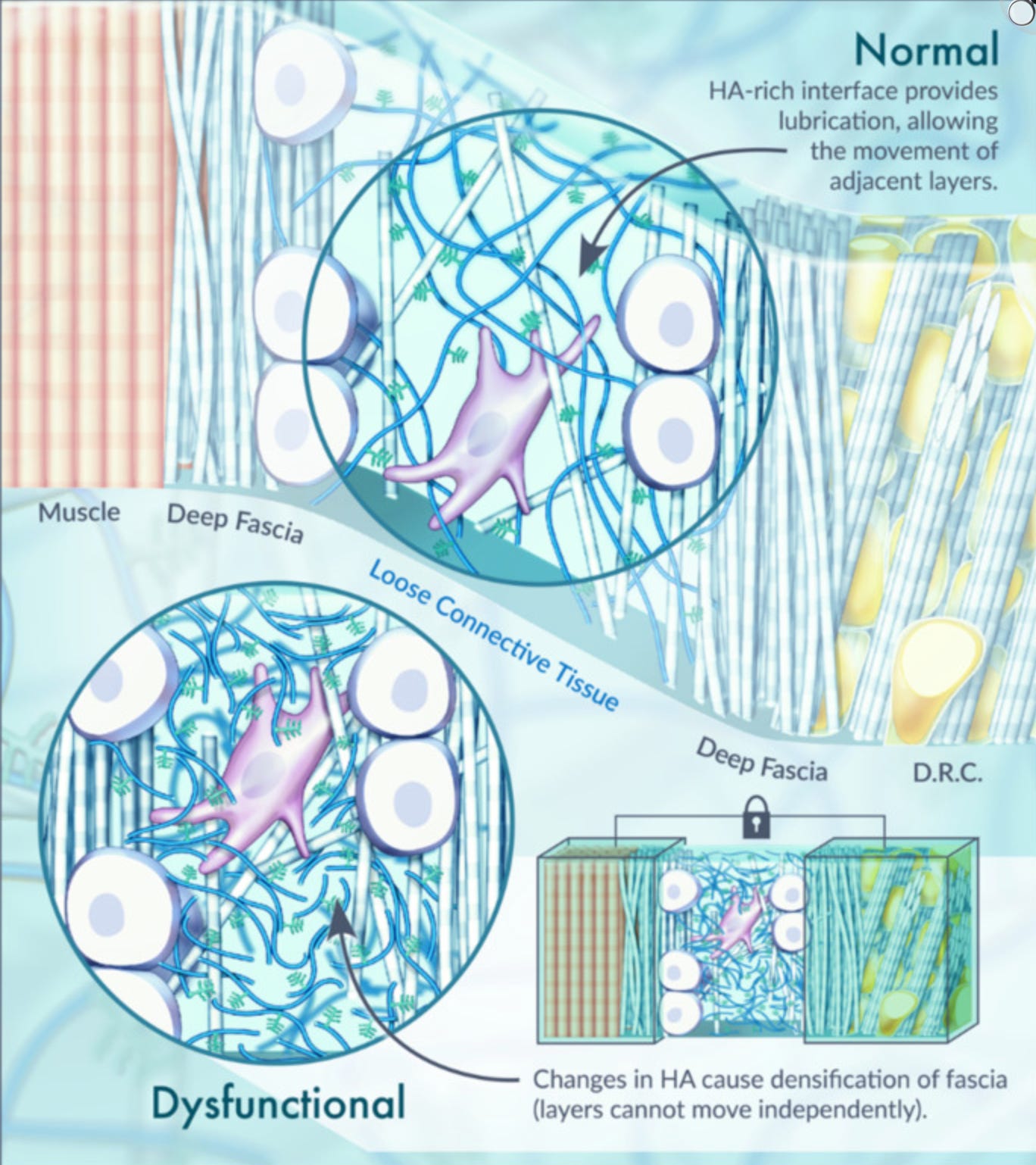
This state has a name. Stecco’s group calls it densification. It is a specific, measurable, physical change in the gel between fascial layers. That gel goes from fluid and slippery to viscous and sticky. When it does, the layers stop gliding. You feel it as stiffness, as heaviness, as a body that has to work harder to move through the same range it used to move through freely.
Note: Densification is not the same thing as fibrosis, and the difference decides what you can actually do about it. Fibrosis is scar tissue. It happens when repeated stress or injury drives the fibroblast cells to lay down excess collagen in disorganized cross-linked sheets. That new collagen becomes structural and permanent. Reversing fibrosis takes months to years and often does not happen at all. Densification is different. It is a fluid problem. The hyaluronan is still there and the tissue architecture is intact, so all you have to do is get the hyaluronan to unfold again and pull water back in. Densification can reverse in days to weeks with the right inputs.
Why does densification happen in the first place? First, immobility. When a region of fascia stays still for hours, the local hyaluronan slowly aggregates because nothing is stirring the fluid. This is why sitting all day makes the hips and lower back tight, and why sleep produces morning stiffness. Second, inflammation. Any injury, infection, or chronic irritation shifts the biochemistry around fasciacytes and drives them to overproduce hyaluronan, which then aggregates. Third, temperature and mineral state. Cold tissue with poor mineral balance holds hyaluronan in a more tangled, sticky form than warm tissue with good mineral balance. Those are the proximate triggers. There is also a hormonal and metabolic layer sitting underneath that decides how easily a body densifies in the first place, and we will get to that below.
Your tissue has a melting point
Paolo Matteini, an Italian biophysicist studying connective tissue at the Nello Carrara Institute of Applied Physics, ran concentrated hyaluronan through calorimetry to map its structural transitions. He found a softening transition starting around 25 to 35 degrees Celsius and a fuller gel-to-fluid transition between 45 and 60 degrees Celsius. In plain terms, hyaluronan changes state with heat. Warm it up and the aggregated gel loosens toward a more fluid state. Cool it down and it stiffens back into a stickier one.
Remember how easy it is to stretch in a sauna? People do it subconsciously in there all the time. Heat makes the body feel open. I think many old heat traditions were built around that felt truth long before anyone could explain the mechanism: Russian banya, Finnish sauna, Japanese sento, Turkish hammam. These traditions did not survive centuries just because they felt nice. They survived because they worked. They shift the physical state of connective tissue back toward its fluid form, restore sliding between fascial layers, and reset the body from the cold, tight, densified state that winter and stress push it into.
The banya specifically pairs high heat with mechanical work in the form of birch or oak leaves swatting the skin. Read that in light of what we just covered. The heat is shifting the hyaluronan back to its fluid state. The swatting drives blood flow into the superficial fascia and skin, which delivers heat deeper into the tissue, brings fresh oxygen and glucose to the fasciacytes, and clears local metabolic waste. Which is why a proper banya session leaves the body feeling looser, warmer, and lighter for days afterward.

I am a firm believer that twenty minutes of real heat, followed by full-range movement while the tissue is still warm, can do more for fascial sliding than weeks of stretching in a cold room.
This is also why a hot bath at the end of a stiff day can take the body from tight and guarded to warm and mobile.
There is a second lever hidden inside the heat one, and it is the beginning of the mineral story.
Researchers studying hyaluronan with ultrasound velocimetry found that sodium changes how the molecule folds in solution. Without enough sodium around, hyaluronan goes through slow, sticky transitions as it warms and cools. Add sodium and those sticky states get suppressed. The chain moves more freely between conformations. Hyaluronan in a well-salted tissue behaves better than hyaluronan in a low-salt, over-diluted tissue. Minerals are not a side character in tissue hydration. They change the physical state of the gel itself. This is the first hint at why the mineral content of what you drink matters more than the volume.
The metabolic core: your fascia is built from sugar and burned energy
Hyaluronic acid does not appear out of nowhere. It is built by an enzyme called hyaluronan synthase, sitting on the plasma membrane of your fasciacytes. That enzyme takes two building blocks from inside the cell and stitches them together into the long hyaluronan chain. The two building blocks are UDP-glucuronic acid and UDP-N-acetylglucosamine. Both come from glucose. Both are downstream of the sugar you burn for energy. The enzyme also requires magnesium as a cofactor.
Follow this through. To build the molecule that holds water in your fascia, your cells need glucose coming in, enough ATP to run the synthesis, and magnesium available to run the enzyme. All three are conditions of a healthy metabolism.
Now the crucial part. The cell has a sensor called AMPK. AMPK stands for AMP-activated protein kinase, and it activates when the cell is short on usable energy. When ATP is low, AMPK switches on and phosphorylates hyaluronan synthase in a way that reduces the enzyme’s activity. In other words, when the cell is stressed or under-fueled, it can downshift hyaluronan production. It becomes worse at holding water.
A body running on chronic caloric restriction, chronic stress, low carbohydrate intake, low thyroid function, or any other pattern that keeps cellular energy low will suppress hyaluronan production at the enzyme level. No amount of plain water will fix that. No amount of hyaluronic acid supplementation will fix it if the tissue lacks the energy and mineral state to hold the molecule in its functional form. The fix has to come upstream. Adequate carbohydrate. Adequate protein. Adequate metabolic rate. Sufficient thyroid function to keep the whole system running warm.
The lymphatic drain
Densification does one more thing. It can slow local lymphatic drainage.
In 2023, a group led by Giovanna Albertin working with the Stecco lab in Padua published a study using specific staining to look for lymphatic vessels in the superficial fascia of the abdomen. Their staining showed lymphatic vessels running through the superficial fascia, embedded in the same loose connective tissue that carries the hyaluronan-rich gel we have been discussing. In other words, some of the body’s drainage pathways run through the fascia we are trying to keep fluid.
When the hyaluronan gel around those lymphatic vessels turns from fluid to sticky, the drainage slows. Fluid that should be picked up by the lymph and carried out of the tissue starts to sit. The tissue becomes heavier, boggier, puffier. The face looks swollen in the morning. The ankles feel thick at the end of the day. The abdomen feels congested. This is not water retention in the free-water sense. It is stagnation in a densified tissue that has stopped moving fluid the way it should.
The hormonal layer
I have written a lot about hormones, so this part will be brief. You cannot separate fascial hydration from the hormonal environment the tissue is sitting in.
Cortisol suppresses hyaluronan production directly. Dexamethasone, a potent synthetic glucocorticoid used in medicine, has been shown to shut down hyaluronan synthase in human skin cells and lower hyaluronan content within days. Your own cortisol, when chronically elevated, can push in the same direction over time.

Estrogen supports hyaluronan production. When estrogen eventually falls around menopause, hyaluronan levels drop in skin and connective tissue, which is one of the mechanisms behind the sudden dryness, thinning, and stiffness many women notice in that transition. In perimenopause, the picture can be messier because estrogen may swing while progesterone, thyroid support, and stress tolerance are already changing. This is also why some women feel dramatically better on well-managed hormone support.

Thyroid hormone runs the whole metabolic rate that keeps the machinery running. Low thyroid means low ATP, which means AMPK on, which means hyaluronan production down. It also means cold tissue, which means hyaluronan holds a stickier conformation. Low thyroid is a global brake on fascial hydration at every level.
So yes: fascia has a hormonal life. You cannot hydrate the tissue well while ignoring cortisol, estrogen, thyroid, and the metabolic state underneath them.
Piezoelectricity and why hydrated tissue responds better
Collagen fibers, which give fascia its structure, are piezoelectric. This means when they are physically stressed, they generate a small electrical potential. The effect was first documented in bone by Fukada and Yasuda in the 1950s. Later work extended it to tendon and to collagen fibers in general. In fascia, this piezoelectric signal is one of the ways mechanical pressure translates into a biochemical signal that tells the cells to remodel. When you press on tissue, some of that pressure becomes an electrical current that reaches the cells producing hyaluronan, and the cells respond.
When the tissue is dry and densified, the signal weakens, and the cells that should have received it barely register the input. This is why foam rolling on a well-hydrated body actually reaches the fasciacytes and gets a response, while foam rolling on dry, densified tissue barely does anything.
I will cover this in more depth in the mechanical interventions piece later in the series. For the purposes of this piece, the point is that everything you do to hydrate the tissue also makes the mechanical work more effective. It is a compounding system.
Below is the practical part. We will look at the one mechanism that makes a drink actually hydrate, the most effective drinks/food for tissue hydration, and why sweet sports drinks can sometimes make the problem worse.