
The Art of Visceral Self-Massage for Gut Flow
An old-school abdominal practice for moving bile, waking up motility, and restoring the mechanical layer of digestion.

One of the things that surprised me when I moved to the US is that nobody really works your abdomen. Your doctor might tap it briefly at a physical, but nobody palpates with intent or examines what is actually going on under there, and even massage therapists skip it entirely unless you find someone exceptional with real visceral training, who is rare and hard to come by.
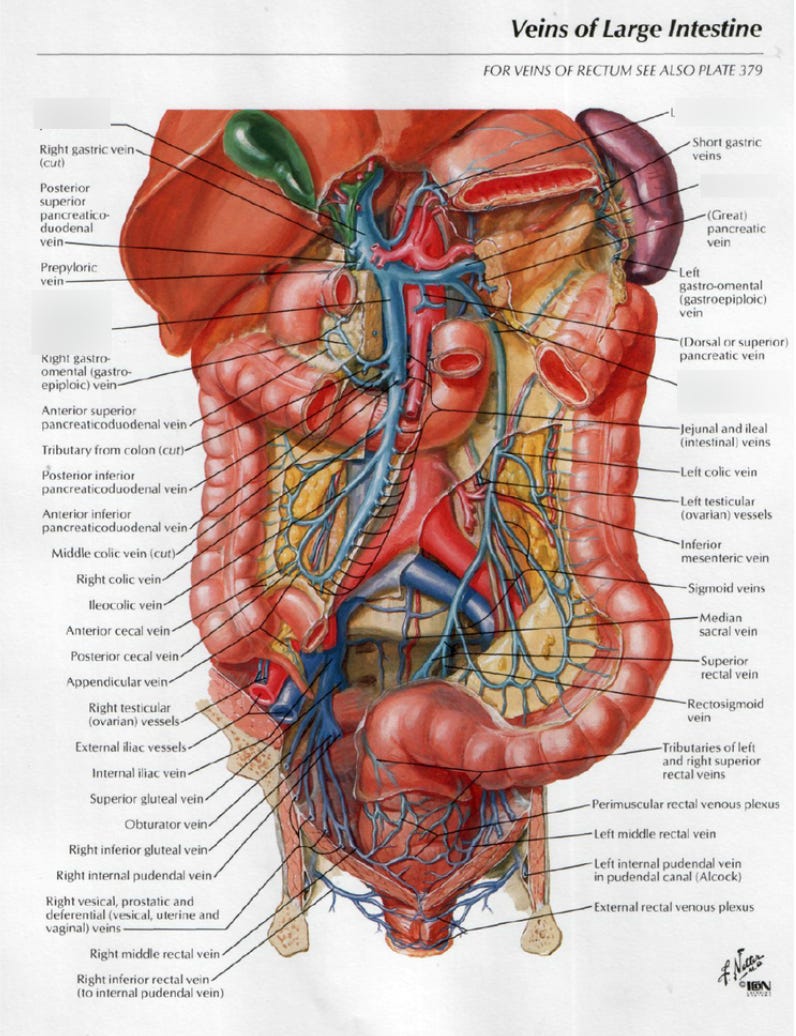
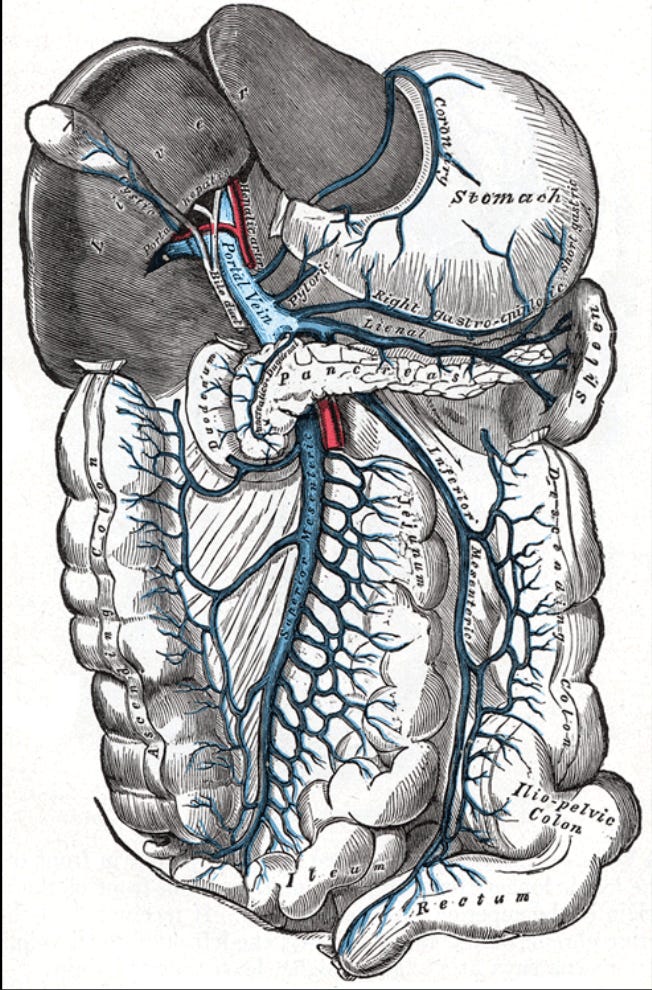
This is strange, because the abdomen is the most innervated, most mechanically active, most metabolically central region of the human body. It is where the vagus nerve does most of its work. It is where the portal vein delivers most of the liver’s blood supply, and where most of the body’s lymph originates. It is where bile is stored, where insulin is released, where the entire chemistry of digestion happens. And it is where half of what sends people to specialists comes from. Yet the one place that needs daily attention is the one place nobody touches, including the patient.
This is the gap visceral self-massage fills.
A little bit of history
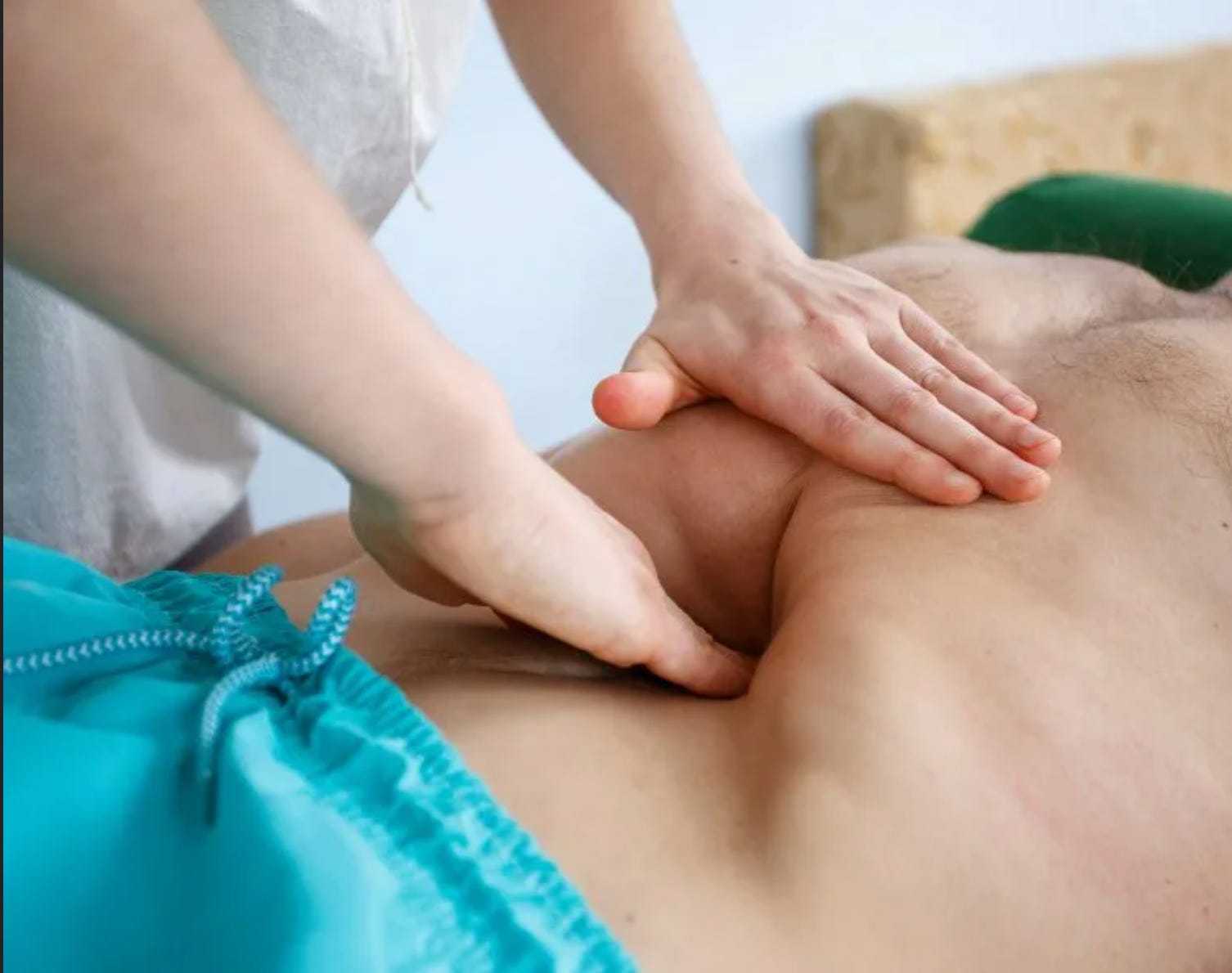
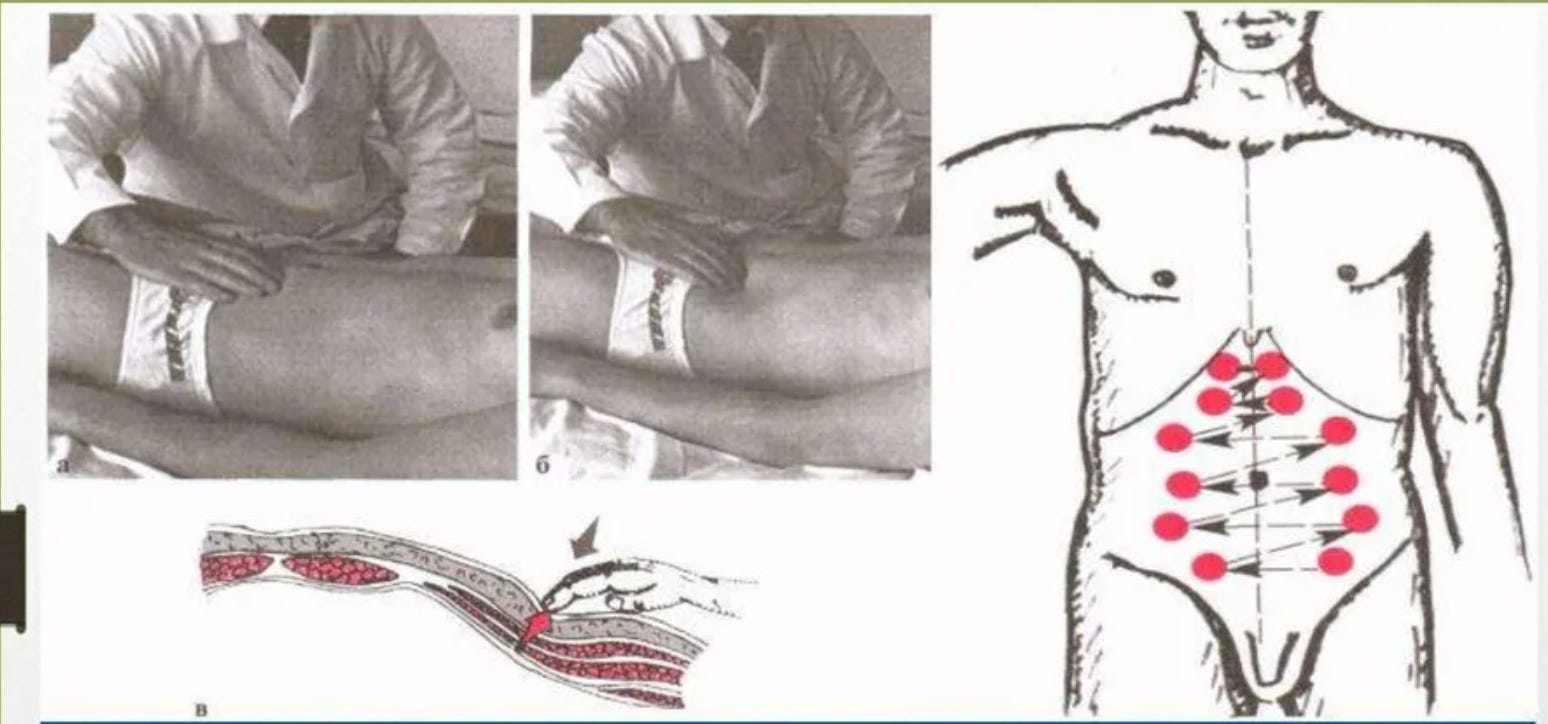
In Russia, abdominal manipulation has been practiced for centuries. Village healers worked the belly with their hands, passed the knowledge down through generations, and treated everything from digestive issues to back pain to women’s problems through the abdomen. In the 1980s, a former judo and sambo champion named Alexander Ogulov was treated by one of these old practitioners after an injury. He recovered. He apprenticed. Then he formalized the method, got a Soviet patent in 1994, and built a school in Moscow that has trained thousands of practitioners worldwide. He called it visceral chiropractic. Russians often call it old Slavic abdominal massage.
In France, an osteopath named Jean-Pierre Barral was doing dissection work in the 1970s and noticed something important. Organs are not free-floating sacks. They are suspended in a continuous web of fascia, ligaments, and mesentery (the fan-shaped membrane that anchors the small intestine to the back wall and carries its blood, nerve, and lymph supply). When that web gets stiff, organs cannot move properly. He called it visceral manipulation, built a school, and TIME magazine eventually named him one of the top healing innovators of the millennium.
Two lineages, different vocabularies, almost identical premise. The abdomen is the mechanical center of the body, and most of us have stopped touching it.
What actually happens in there…
The abdominal cavity is a pressurized, compartmentalized space where every organ is held in place by ligaments and slides against its neighbors on slippery membranes. The liver sits tucked under the right rib cage. It hangs from the diaphragm above by a pair of strong ligaments and tethers down to the stomach and duodenum through a sheet of connective tissue called the lesser omentum. The stomach hangs from the diaphragm too. The transverse colon drapes across the middle like a hammock. The small intestine is suspended from the back wall by the mesentery, fanning out into every loop of bowel. The kidneys sit in pads of fat and fascia against the back wall. The uterus floats between the bladder and rectum, held in place by a few ligaments that anchor it to the pelvic bones.
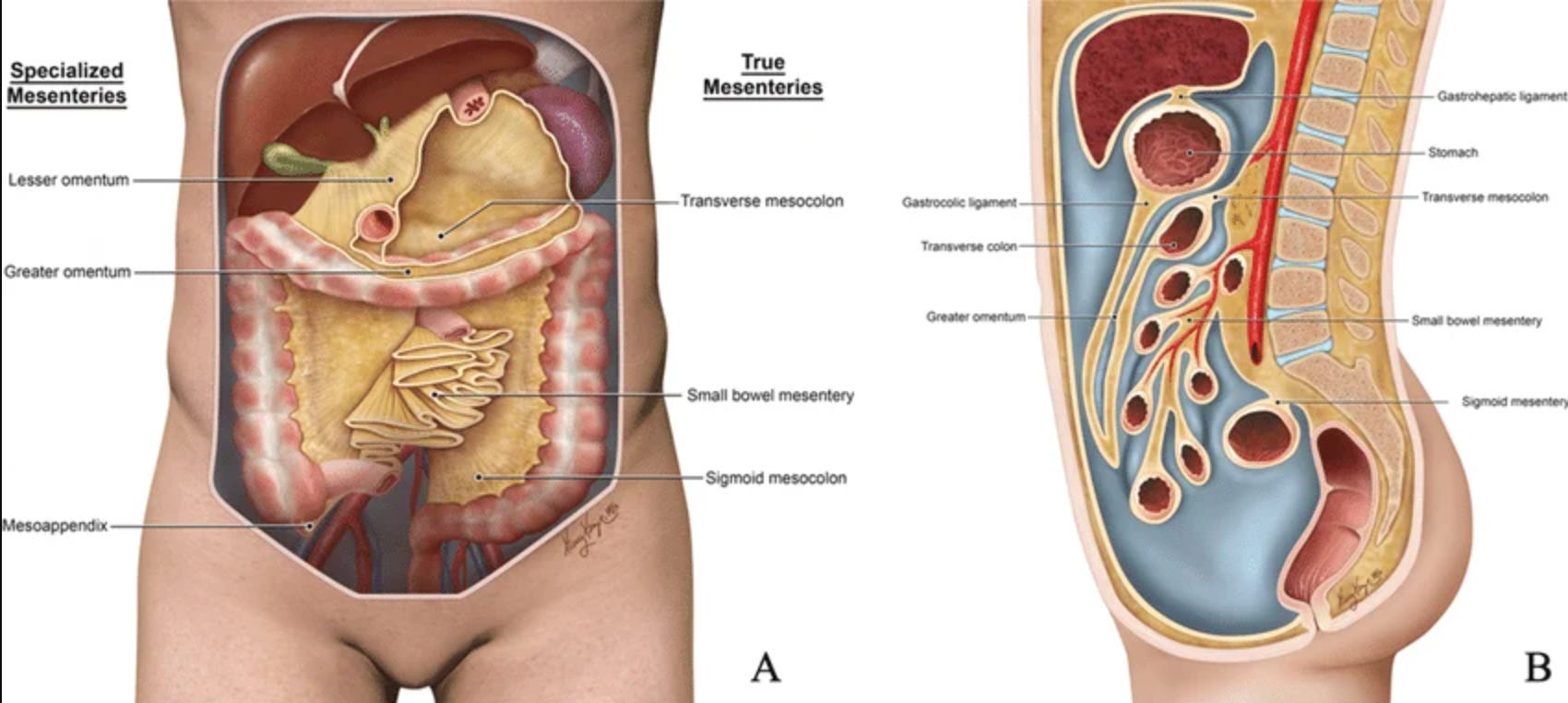
All of this is supposed to move. When you breathe in, the diaphragm drops about 1.5 inches and pushes everything down. When you breathe out, everything rises back up. That is 20,000 to 24,000 cycles of organ pumping every day. This is how venous blood drains from the liver, lymph moves out of the gut, bile shifts in the gallbladder, and the colon receives the mechanical signal to keep peristalsis going.
Now picture what happens when posture collapses, the diaphragm stops moving fully, the abdominal wall stays guarded under chronic stress, and years of shallow breathing reduce normal diaphragm excursion. The pumping fails and organs stop sliding. Fascia thickens around them. Venous and lymphatic drainage backs up. The gallbladder gets sluggish, bile gets thick, the liver gets congested. The small intestine stops moving cleanly. Periods get heavier as pelvic venous return slows. Lower back pain shows up too, often because the kidneys sit on the psoas muscles and share fascial tension with them; the kidneys themselves are not accessible from the front of the abdomen, but restoring diaphragm motion and decompressing the surrounding tissue gives them back the space and movement they need.

This is the framework. The question is what to do about it.
The mechanisms: what the work is actually doing
There are six mechanisms by which working the abdomen with your hands changes physiology.
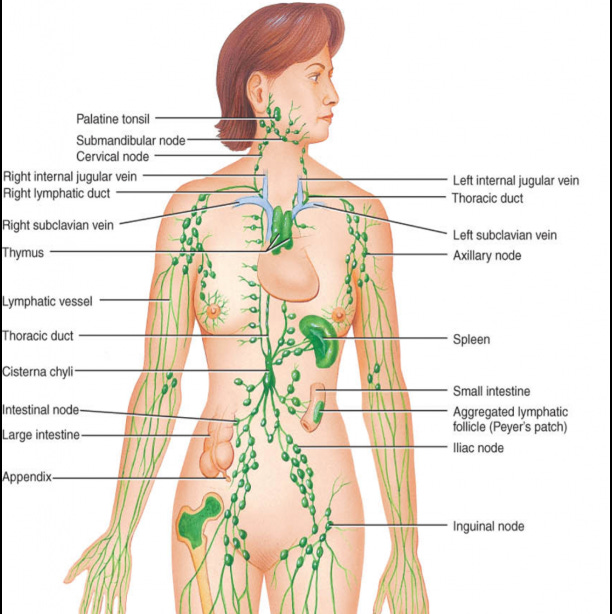
Mechanical drainage and reactive hyperemia. Pressing and releasing the abdomen acts like an external pump. Venous blood and lymph drain by compression, not by arterial pressure. The portal vein carries roughly 70% of the liver’s blood supply, and it has no pump of its own. It moves on intra-abdominal pressure changes from breathing and movement. When you sit slumped at a desk for ten hours, that pressure cycling collapses. Self-massage restores it manually. Most of the body’s lymph originates in the abdomen, gathered up from the gut through the mesenteric lymph channels and collected in a small sac called the cisterna chyli, which sits in front of the spine at the level of the navel. From there, lymph travels upward through the chest and empties back into the bloodstream near the collarbone. Move the gut, you move the lymph. There is a second effect on top of drainage. When you hold pressure on an organ for 30-60 seconds, you temporarily restrict arterial inflow. When you release, the body floods that area with fresh blood at higher pressure than baseline. This is reactive hyperemia. The organ gets a wash of oxygenated blood it does not get during normal circulation. This is why sustained holds matter more than quick rubbing.
Stretching tense organs. Organs contain smooth muscle, blood vessels, nerves, membranes, and fascial attachments, so they can become guarded, tender, congested, or mechanically restricted. A spasm in the gallbladder sphincter, a contracted segment of bowel, a tight pancreatic duct, fascia gripping the liver after a stressful year. You cannot stretch these with a foam roller. You can stretch them with your hands, by applying slow, sustained, directional pressure. The mechanical input acts through smooth muscle tone, fascial glide, local circulation, stretch receptors, and autonomic reflexes. Hold, breathe, release. The tissue lets go.
Smooth muscle stimulation. The colon responds to mechanical pressure. Multiple randomized controlled trials, including a 2020 study by Mokhtare and colleagues, found abdominal massage improved constipation symptoms, and the combination of massage plus polyethylene glycol worked better than either alone. A 2009 Swedish RCT by Lämås and colleagues found abdominal massage significantly decreased gastrointestinal symptom severity, constipation syndrome scores, and abdominal pain scores compared to laxatives alone. The mechanism is straightforward. Mechanical pressure on the colon triggers the gastrocolic reflex and stimulates peristalsis directly.
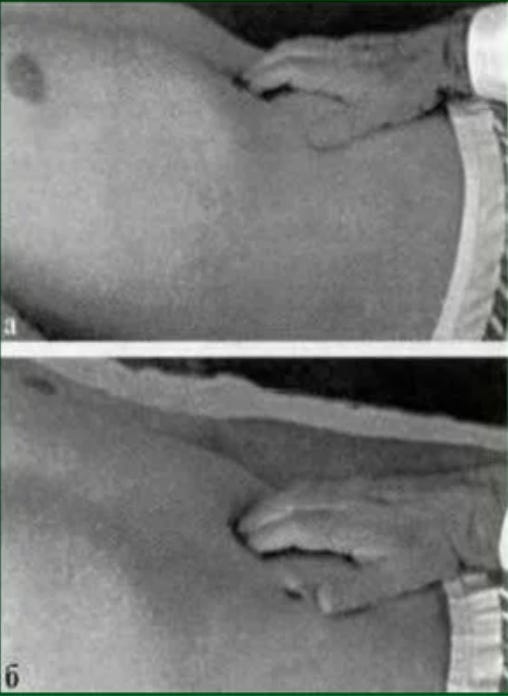
Bile flow. Bile is supposed to flow. When it sits, it concentrates, thickens, crystallizes. External pressure and release over the right upper quadrant support the normal mechanical environment for bile flow by improving diaphragm motion, local tissue mobility, and pressure cycling around the liver, gallbladder, and duodenum. A 2016 clinical report documented that daily self-abdominal massage reduced recurrent common bile duct stones in patients with prior cholecystectomy. This lines up exactly with what every visceral technique along the bile duct line is doing mechanically. Move bile, prevent stasis. Prevent stasis, prevent stones, prevent the cascade that follows congested bile: poor fat digestion, poor hormone clearance, poor toxin clearance, skin issues, hormonal chaos.

Vagal stimulation. The vagus nerve carries about 80% of the parasympathetic fibers in the body and innervates everything from the esophagus to the proximal two-thirds of the transverse colon. Slow, deep, sustained pressure on the abdomen, combined with diaphragmatic breathing, activates parasympathetic tone. You can measure this with heart rate variability. People who massage their abdomen slowly for ten minutes often feel sleepy. That is vagal tone rising and sympathetic tone dropping.
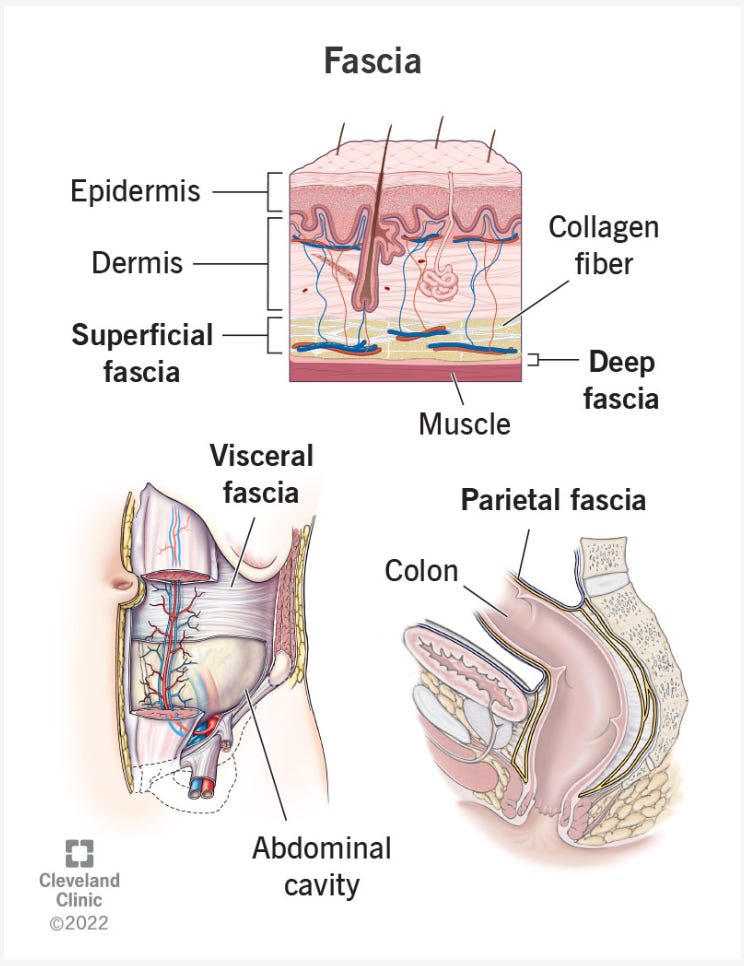
Fascial release. The visceral fascia is continuous with the somatic (parietal) fascia. A restriction around the liver pulls on the diaphragm, which pulls on the lower ribs, which pulls on the thoracic spine. A 2018 study on visceral manipulation found a single session of stomach and liver work reduced neck pain in patients with chronic neck pain, with effects still measurable seven days later. This is why people who get one visceral session often walk out saying their shoulder feels different. The fascia does not respect anatomical boundaries.
What this is good for
Chronic constipation
Sluggish bile flow and gallbladder congestion
Post-meal bloating and heaviness
Heavy or painful periods
Pelvic congestion, dragging sensations, mid-cycle heaviness
Diaphragmatic tension and shallow breathing
Lower back pain with no orthopedic explanation
Right shoulder tension that does not respond to stretching
Chronic morning grogginess
Cold extremities tied to poor splanchnic circulation
Sluggish lymphatic drainage from the gut
The general parasympathetic shutdown of sitting all day under fluorescent lights
Persistent bloating that no probiotic or elimination diet has fixed
Post-cholecystectomy bile flow maintenance
Recovery from rich meals, travel, alcohol, or any digestive overload
IBS-type symptoms with mixed pattern
Stress-driven dyspepsia and the “nervous stomach”
The vague but persistent sense that your digestion is just off
It pairs with tubazh and bile-supportive protocol because it addresses the mechanical layer those interventions cannot reach. Bile responds to chemistry, but bile also responds to pressure. Tubazh flushes from the inside. Self-massage pumps from the outside. Together they do what neither does alone.

When you should not do this
Do not work your abdomen if you have:
Active gallstones causing colic, or known large stones
Active kidney stones
Acute appendicitis or any acute abdominal pain you cannot explain
Recent abdominal surgery (wait at least 8-12 weeks and get clearance)
Abdominal aortic aneurysm
Active inflammatory bowel disease flare
Pregnancy
IUD in place (no deep pelvic work)
Active abdominal infection or fever
Fever, vomiting, jaundice, or blood in the stool
This is a self-practice for gentle mechanical support. If you have cancer in the abdomen, or a history of pelvic surgery, get evaluated first and modify accordingly.
How to read your own abdomen first
Before technique, diagnostic touch. Most people have no idea what their own abdomen feels like, because nobody has ever taught them to pay attention. So you press, and everything feels the same, and you cannot tell what you are working on. Here is what to feel for.
Pulsation. When you press in slowly along the deep midline, slightly above the navel, you will feel the aortic pulse. This is normal. The aorta runs from the heart down through the abdomen to the legs, and a clean rhythmic pulse under your fingers is exactly what should be there.
Hardness. Soft, pliable tissue is normal. Rope-like bands of hardness usually mean muscular guarding, fascial adhesion, or a loaded segment of colon. Hard knots in specific positions often correspond to organs holding tension. The right upper quadrant gets hard with bile stasis. The right lower quadrant (cecum) gets hard with ileocecal valve dysfunction. The left lower quadrant (sigmoid) gets hard with chronic constipation. The area just above and to the right of the navel gets hard with duodenal tension, common in stress-driven digestive issues.
Pain quality. Sharp, stabbing pain when you press means stop. Dull, deep ache that feels “right” and releases as you hold pressure means you are on a useful spot. Pain that radiates somewhere else (right shoulder, low back, between the shoulder blades) is a viscerosomatic referral and tells you the organ is involved.
Breath asymmetry. Place your hands on different quadrants and breathe deeply. If one quadrant expands less than the others, that quadrant has restricted fascial mobility. That is where you spend your time.
Spend two minutes doing this assessment before every session at first. As you do this regularly, your hands will start to know without conscious effort.
The full protocol
This is the complete 10-step visceral self-massage sequence I use myself, drawn from Ogulov’s method and adapted for safe self-practice.
This is the practical part: where to place your hands, which direction to press, how deep to go, how long to hold, and how to move through the abdomen without forcing it. The full sequence takes 20 to 25 minutes with proper one-minute holds. Once your hands know the route and the tissue softens, the condensed version takes 8 to 10 minutes.
Along the way, I explain why certain areas matter for common patterns like post-meal heaviness, bile stagnation, chronic bloating, SIBO-type symptoms, constipation, pelvic heaviness, painful periods, shallow breathing, and pressure under the ribs.